
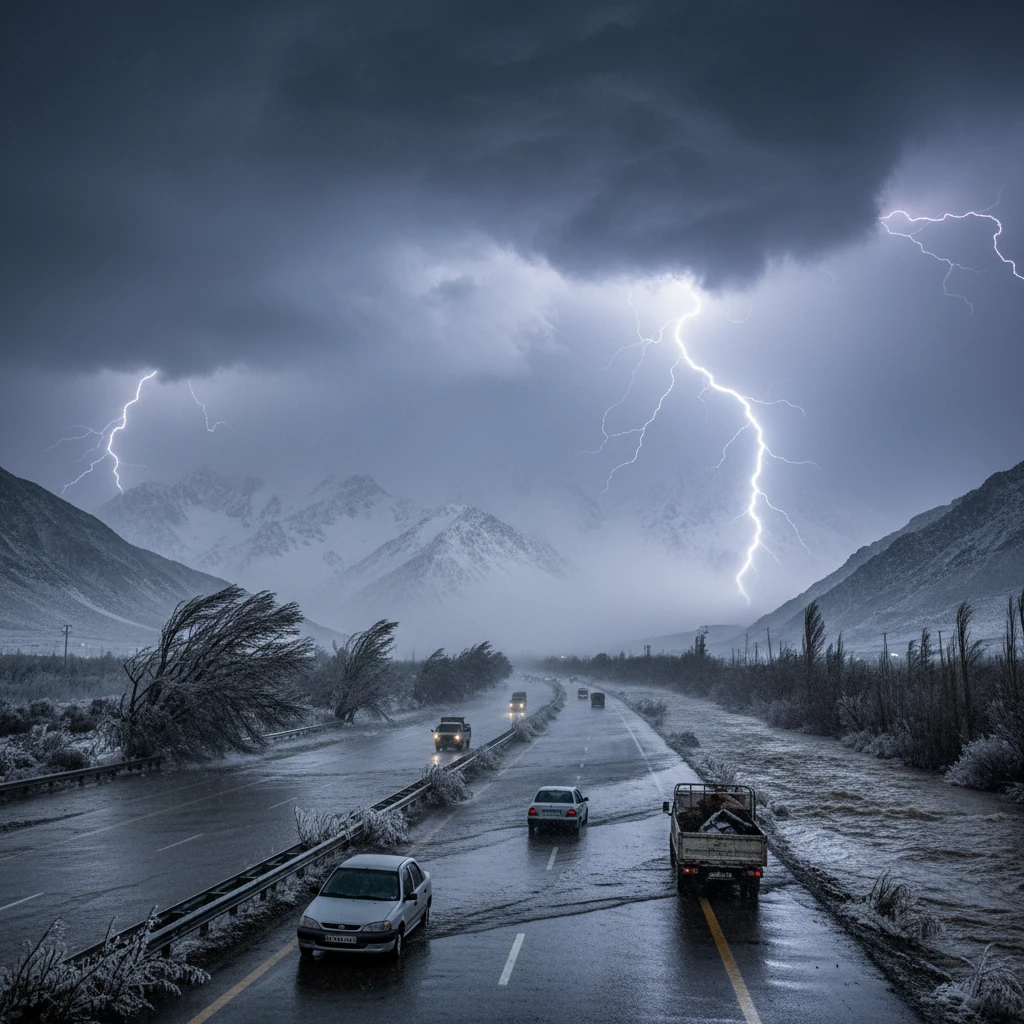
Red Alert Issued by Meteorological Authority: Second Wave of Torrential Rainfall to Hit Southern Iran / Avalanche and Severe Frost Risks in Mountainous Areas
The Head of the National Center for Weather Forecasting and Climate Crisis Management has announced the issuance of a red weather warning due to the arrival of a second wave of intense and torrential rainfall affecting southern parts of Iran, warning that most mountainous regions of the country will face serious hazards, including avalanches, blizzards, severe frost, and reduced visibility on Thursday and Friday (December 18 and 19).
Speaking to ISNA, Sadegh Ziaian referred to the continued activity of active weather systems across the country and stated that, based on the latest forecast models, unstable and highly dangerous weather conditions are expected to prevail in most mountainous regions—particularly the Zagros and Alborz mountain ranges, as well as highland areas of central and northeastern Iran—over the next two days.
Referring to the issuance of a red-level warning for southern regions, Ziaian said that widespread flooding, sustained snowfall, severe blizzards, and major disruptions to transportation are likely in the high-altitude areas of southern Iran, posing significant risks to life and property.
Persistent Precipitation and Poor Visibility in Mountainous Areas
Explaining the weather outlook for Thursday, Ziaian noted that precipitation systems will remain active over the mountainous and foothill regions of the Zagros—especially the central Zagros—along with the Alborz range, central highlands, and northeastern elevations. These conditions will be accompanied by cloud cover, fog, significantly reduced visibility, snowfall, blizzards, strong winds, and locally thunderstorms.
Torrential Rainfall and Flooding Across Southern Regions
The head of the National Meteorological Center further warned that from Thursday afternoon through Friday, the second wave of intense and torrential precipitation will widely impact southern Iran. In low-lying areas, heavy rain and thunderstorms, hailstorms, flash floods, surface runoff, river overflows, and landslides are expected. In mountainous and upstream areas, heavy snowfall, blizzards, and a heightened risk of avalanches are forecast.
Heightened Avalanche and Frostbite Risks
Ziaian emphasized that recent widespread snowfall has led to the accumulation of fresh snow and the formation of snow cornices along ridgelines and avalanche-prone routes, significantly increasing avalanche risk. He strongly advised against travel and movement through such vulnerable areas.
He added that blizzard conditions, severe visibility reduction, disorientation from routes, strong winds, and intensified wind chill could result in severe frostbite, especially in high-altitude regions. The persistence of sub-zero temperatures combined with strong winds will further exacerbate the dangers facing individuals in mountainous areas.
Weather Conditions in the Northern Highlands of Tehran
Regarding the mountainous areas north of Tehran, Ziaian stated that Thursday’s weather will be mostly cloudy with strong winds and, at times, snowfall, blizzards, and increased wind speeds. On Friday, conditions will range from partly cloudy to cloudy, with stronger winds at summits and ridgelines and a chance of isolated precipitation.
Final Warning to Mountaineers and Outdoor Enthusiasts
In conclusion, Ziaian stressed that due to unfavorable weather conditions across most mountainous regions, the elevated likelihood of hazardous weather events, and the potential for loss of life, all mountain-related activities—including mountaineering, canyoning, technical climbs, recreational flights, and similar outdoor pursuits—should be strictly avoided until conditions improve.
- source:https://www.isna.ir/
- author:DGS
- 1404/09/27