Safety Crisis in Small Industries of Iran: From Worn-out Infrastructure to Ineffective Oversight
The tragic death of nine workers in the Dolatabad Industrial Town fire in Isfahan has once again sounded the alarm over occupational safety and monitoring within industrial units nationwide. Experts warn that the absence of standard fire suppression systems and weak oversight mechanisms have turned industrial zones into ticking time bombs that could explode at any moment.
Detailed News Report
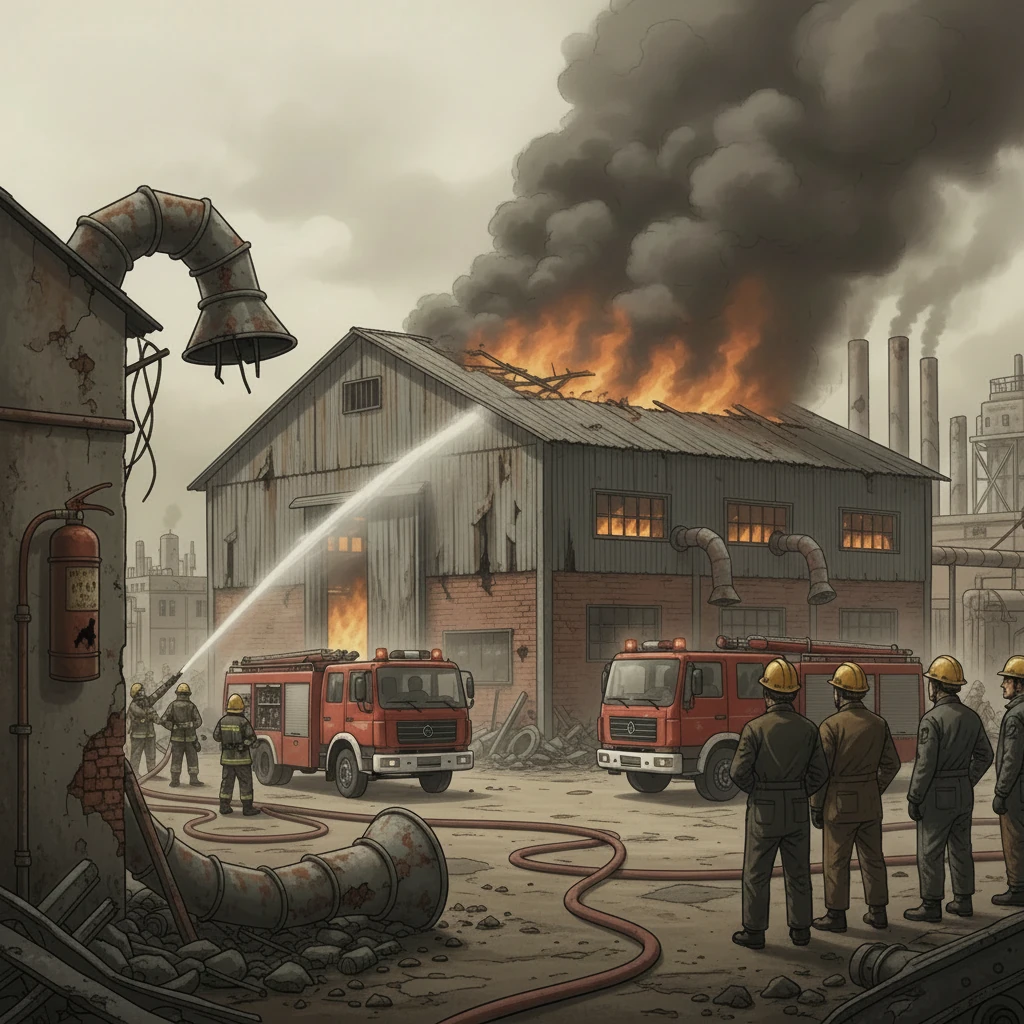
Last week, a deadly fire broke out in a production unit located in Dolatabad Industrial Town, Isfahan. The incident claimed the lives of nine workers due to suffocation caused by toxic gases from the blaze. This tragedy has brought renewed attention to the severe deficiencies in the safety structure of small and medium-size industrial units across the country. Most of these units operate in densely packed industrial towns, where the high proximity of factories means that fires and explosions spread rapidly, causing chain reactions and mass casualties.
Occupational safety specialists and labor activists emphasize that many industrial zones lack basic safety infrastructure and standard equipment. The significant distance from emergency response and fire stations, the absence of in-plant fire suppression systems, inadequate smoke and gas ventilation in workshops, and even the shortage of proper emergency exits are among the recurring challenges that have remained unaddressed for years.
Expert and Union Perspectives
In an exclusive interview with ILNA, Ali Akbar Showkat, former member of the Social Security Organization’s Board of Trustees and Chairman of the National Construction Workers’ Association, strongly criticized the current situation:
“When an incident like Dolatabad happens, everyone points fingers at labor inspectors. But the problem is much deeper; we have an inspection system that is outdated, understaffed, and unmotivated. Heavy workloads, low wages, and disregard for the professional dignity of inspectors have driven safety oversight into a state of crisis.”
He continued: “We shouldn’t put all the blame on inspectors. The system needs a fundamental shift. Instead of focusing on post-incident reports, our priority must be prevention and standardization.”
According to Showkat, many workshops lack even the most basic safety facilities. Installing proper ventilation systems, maintaining safe distances between buildings and combustible materials, using fire-resistant materials, and training safety staff are essential requirements for industrial operations. Yet in most industrial towns, these standards are ignored.
Government Oversight: The Missing Link in Industrial Safety
A large part of experts’ criticism is aimed at the government’s fragmented oversight structure. Ministries and regional authorities — including the Ministry of Cooperatives, Labour, and Social Welfare, the Ministry of Industry, Mine, and Trade, and provincial governorates — each play a role in licensing and inspecting industrial units. But in practice, these responsibilities are uncoordinated and insufficient.
Showkat emphasized:
“During the design and construction of industrial towns, fire stations, safe emergency routes, and unit safety maps must be mandatory. However, most of these tasks are left to the Ministry of Labour’s inspectors, who neither have the technical capacity nor the manpower and budget to execute them.”
He noted that in provinces like Isfahan, with tens of thousands of industrial workshops stretching from Morche-Khort to Dolatabad, the number of inspectors is extremely limited, making effective monitoring impossible. This lack of coordination means inspectors mostly arrive after disasters occur, leaving preventive measures unattended.
Proposed Structural and Financial Reforms
To break this cycle of crisis, Showkat advocates the creation of an independent body known as the “Safety Engineering Organization” — tasked with enforcing industrial safety standards, conducting inspections, and evaluating facilities. This organization would directly pay its engineers and inspectors through government funds.
“When safety engineers are employed and paid by employers, their professional independence is compromised. To protect workers’ lives, the payment structure for inspectors must be independent, preventing conflicts of interest.”
Showkat recalled the effective measures introduced during the tenure of Ahmad Haft-Tan as Deputy Minister for Labour Relations. That period saw mandatory training for contractors, proactive inspections, and the requirement of safety clearance before project initiation — leading to a notable drop in workplace fatalities. Unfortunately, these achievements were abandoned in subsequent administrations.
Financial Solutions for Safety Upgrades
One major obstacle to improving safety is the financial strain on small and medium industries. Showkat argued:
“The government must acknowledge that the cost of prevention is far less than the cost of disaster. The losses from shutting down an industrial unit, paying compensation to victims’ families, dealing with worker disabilities, and the broader social costs are several times higher than the investment needed in modern safety measures.”
He proposed that specialized banks — including Bank of Industry and Mine, Bank of Tose’e Ta’avon (Development Cooperation), and Bank Refah Kargaran — offer low-interest loans specifically for safety modernization and renovation projects. Additionally, the Ministry of Industry and the Social Security Organization could allocate part of their funds to support safety infrastructure directly, given they both benefit from reducing workplace accidents.
Conclusion and Outlook
The Dolatabad disaster is just one of many similar incidents occurring each year in Iran, claiming the lives of hundreds of workers. Experts warn that without structural reforms in safety standards, training, financing, and coordinated oversight, the country will continue to fall further behind international occupational safety benchmarks.
For Showkat and other union activists, saving workers’ lives demands a national will — one that recognizes human life as a priceless asset, not just another cost in production figures, and treats occupational safety as a vital investment in the nation’s future.
- source:https://www.ilna.ir/
- author:DGS
- 1404/10/01