
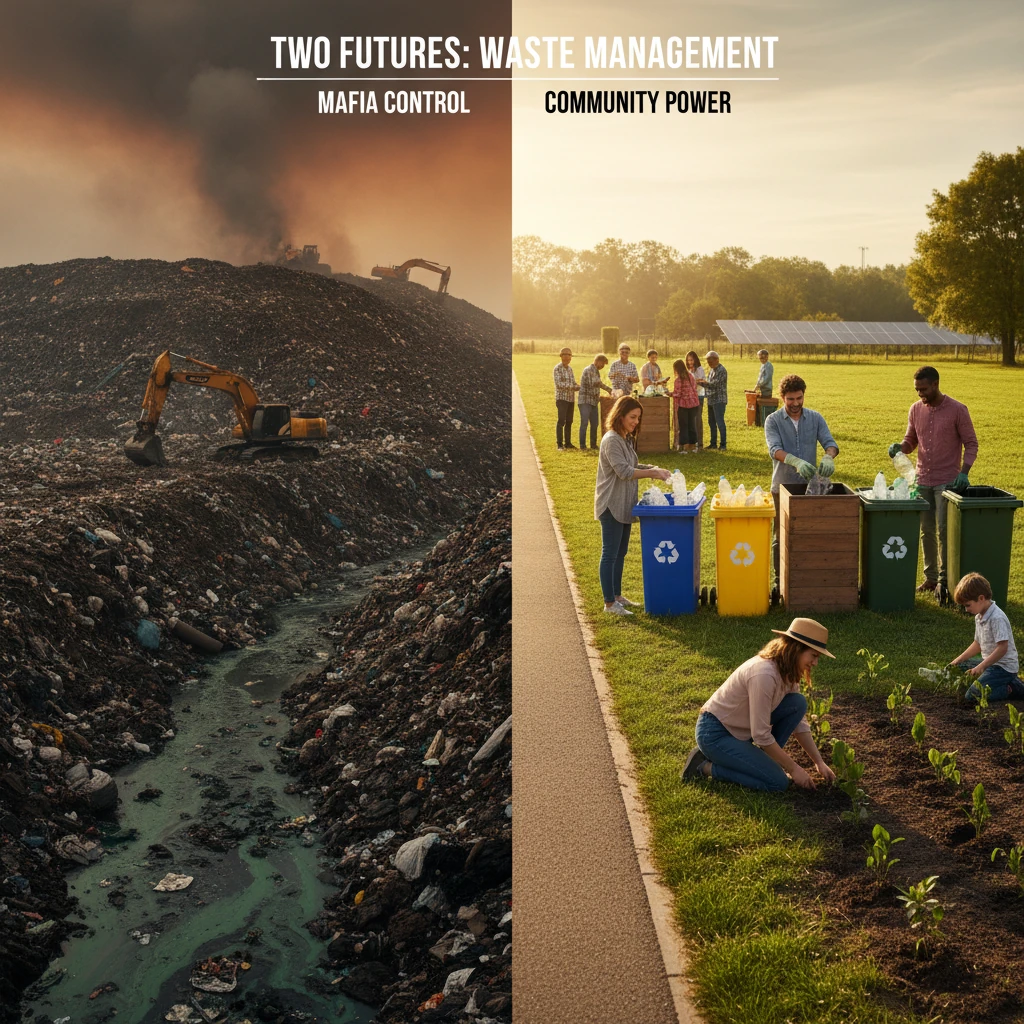
“The Unequal Battle Against Mountains of Waste: Innovative Social Project Stifled by ‘Garbage Mafia’ and Systemic Apathy”
As millions of liters of toxic leachate contaminate Iran’s water and soil daily, a community-driven initiative centered on “education and social participation” has demonstrated remarkable success, reducing landfill waste by up to 75% and even permanently closing a major dumpsite. However, the project’s founder claims that “vested interests” and “behind-the-scenes waste mafias” are actively blocking its expansion to major metropolises.
Aref Ahangar, the founder of the MAP Project (a community-based waste management initiative), stated in an interview with ILNA that the project’s philosophy, launched in 2018, is to treat waste management as a “social issue” rather than a purely technical one. He emphasized that without public participation, no technology—whether composting plants, incinerators, or recycling facilities—can solve the crisis. “Waste is produced in the homes of citizens; therefore, the solution must begin at the same point,” Ahangar remarked.
Ahangar, whose company operates under the Mazandaran Science and Technology Park, highlighted the catastrophic situation in northern Iran. Currently, 31 traditional landfill sites exist in Mazandaran alone, mostly situated in the ancient Hyrcanian forests, meadows, or near rivers and the sea.
“Every ton of waste produces approximately 500 liters of leachate,” Ahangar warned. “In Mazandaran, we produce 3,500 tons of household waste daily, resulting in 1.75 million liters of highly toxic, heavy-metal-laden leachate that enters the groundwater and food chain. We think we are throwing waste ‘away,’ but that ‘away’ is much closer than we realize.”
Solving the Problem at the Source
The MAP Project distinguishes itself by managing “wet” or organic waste—which accounts for 70-75% of household waste—right at the source. While municipalities and contractors often ignore organic waste due to lack of immediate profit, it remains the primary source of toxic leachate.
“We are the only group managing separated organic waste in local composting workshops,” Ahangar explained. “When organic waste is kept pure and not mixed with other materials, pollution is drastically reduced. In our sites, seeds like cucumber and tomato naturally sprout—a phenomenon that would never occur in a toxic traditional landfill.” This process transforms waste into high-quality, chemical-free organic fertilizer for agriculture and gardening within two to three months.
Tangible Success: Iran’s First “Trash-Can-Free” City
The project’s results have been transformative: Darab-Kola Village: Reduced monthly waste from 93 tons to just 20 tons (a 75% decrease). Kiakala City: Successfully diverted 60 tons of waste daily, leading to the permanent closure of a 60-year-old landfill. Kiakala became known as “Iran’s first city without street trash cans.” Pol-e Sefid: Converted a hazardous forest landfill into a clean management site that now hosts educational student tours.
The Barrier: The “Waste Mafia” and Financial Interests
Despite receiving the National Environment Award in 2023 and having official mandates from the National Waste Management Working Group, the project has failed to scale nationally. Ahangar attributes this to systemic corruption.
“The current management structure in many municipalities has hidden interests often referred to as the ‘Waste Mafia,’” Ahangar alleged. “Their profit lies in lack of transparency. They benefit from two streams: first, ‘mining’ recyclables from mixed waste at landfills using cheap labor; and second, transportation contracts based on tonnage.
Our project, by reducing tonnage and separating at the source, threatens both of these profit margins.”
A Call for a Paradigm Shift
Ahangar also criticized the reliance on expensive and often faulty hardware, such as the Nowshahr incinerator, which caused significant local pollution upon startup. He argued that the world has moved toward cultural and social solutions, which are far more cost-effective.
conclusion
“If even a fraction of the current massive waste management budgets were allocated to social participation models, the results would be visible immediately,” Ahangar concluded. “The problem isn’t a lack of knowledge or technology; it is a lack of political will and a flawed structure that prioritizes profit over public health.”
- source:https://www.ilna.ir/
- author:DGS
- 1404/10/01