
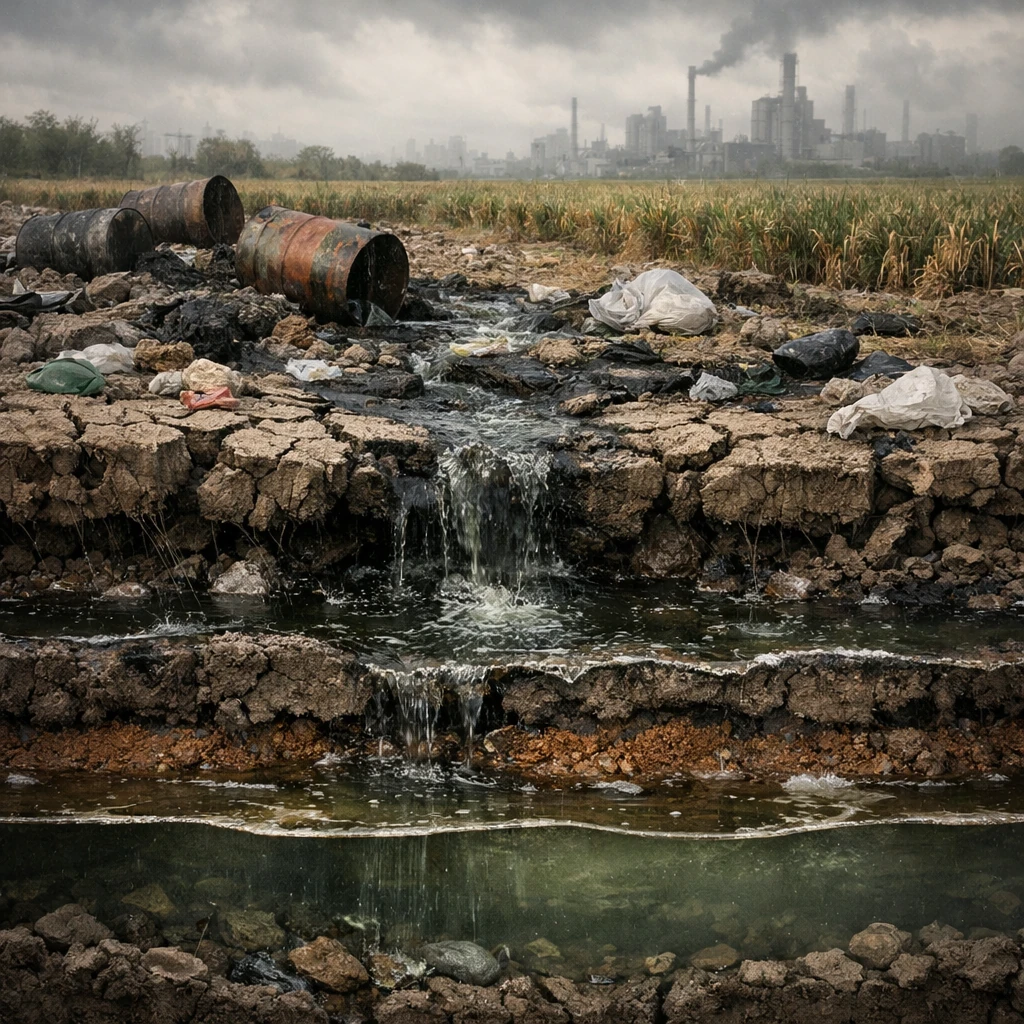
Silent Soil Degradation: A Serious Threat to Public Health, Food Safety, and Water Resource Sustainability in Iran
According to the Supporters of Workers’ Health and Safety News Agency, soil pollution in Iran has emerged as one of the quietest yet most dangerous environmental crises, evolving into a multidimensional challenge within the framework of Health, Safety, and Environment (HSE). This crisis directly threatens human health, food safety, and the sustainability of both surface and groundwater resources.
Although concerns over soil contamination and nutrient depletion were first raised years ago with a focus on metropolitan areas such as Tehran, scientific evidence and official reports now indicate that the problem is by no means confined to a single region. In fact, varying degrees of soil pollution can be observed nationwide. According to the latest findings of Iran’s Parliamentary Research Center and reports by the Department of Environment, approximately 60 percent of soil pollution originates from waste disposal, while more than 21 percent is linked to urban, industrial, and agricultural wastewater—figures that point to serious shortcomings in environmental management and infrastructure safety.
Soil Pollution Exceeding Permissible Limits: An HSE Alarm for Agriculture
Experts warn that in provinces such as Khuzestan, Isfahan, and Kerman, soil contamination levels in certain areas have exceeded permissible standards, raising serious concerns about the production of safe and healthy agricultural products. If left uncontrolled, this trend could lead to the removal of large areas of farmland from the production cycle in the near future. From an HSE perspective, this issue represents not only an environmental threat but also a direct risk to public health and the occupational safety of agricultural workers.
In this context, the Head of the Soil Fertility and Plant Nutrition Research Department at the Soil and Water Research Institute has cautioned that Iran’s soil fertility is on the verge of collapse due to severe organic matter depletion, with soil pollution acting as a major contributing factor to this gradual degradation.
Land Degradation: A Key Concept in Environmental Risk Management
Environmental specialists believe that Iran is gradually entering a phase of crisis known as land degradation—a concept encompassing soil pollution, loss of organic matter, declining biological productivity, soil compaction, erosion, and the conversion of agricultural and natural lands. This process is considered one of the most serious long-term challenges to sustainable development and environmental safety in the country.
Despite official acknowledgment of soil pollution, no comprehensive or transparent national statistics on its extent and severity have been released so far. Many experts argue that should such data become public, the scale of the crisis would appear far more alarming.
Soil Pollution: Linking Food Security and Drinking Water Safety
Mohsen Shahriari Moghaddam, Director General of the Office for Environmental Protection and Management of Water and Soil at Iran’s Department of Environment, explains that under the Soil Protection Law, soil pollution is defined as the introduction or spread of one or more foreign substances into or onto soil in quantities that alter its physical, chemical, or biological properties in a manner harmful to humans, other living organisms, plants, or infrastructure. This definition also includes alluvial and rocky surface layers of the land.
From an HSE standpoint, the most immediate consequence of soil pollution is the threat to food security and consumer health, as many contaminants enter the food chain, some of which accumulate over time in the human body. Additionally, soil contamination directly reduces the land’s production capacity, endangering farmers’ livelihoods and the sustainability of the agricultural economy.
He further notes that soil pollution indirectly affects surface and groundwater resources. Groundwater is recharged through water that percolates through soil layers; therefore, contaminated soil can directly impair groundwater quality as well as surface waters. Pollutants carried by runoff into rivers and reservoirs complete the cycle of contamination, posing significant risks to safe drinking water supplies.
Waste, Wastewater, and Industrial Activities: Major Sources of Soil Contamination
According to Shahriari Moghaddam, soil pollution is a global issue and not unique to Iran. In Iran, the primary sources include municipal and industrial waste, untreated urban and industrial wastewater, excessive use of chemical fertilizers and pesticides, mining activities, oil spills, and airborne particulate matter such as dust storms. These particles often settle on soil surfaces and, when carrying pollutants, contribute further to contamination.
Given Iran’s vast geography, the causes and types of soil pollution vary significantly from one region to another, and even within different cities of the same province. In some areas, waste disposal is the dominant factor; in others, untreated wastewater or oil-related activities play a more significant role.
HSE Conclusion
Soil pollution in Iran is not merely an environmental concern; it represents a critical crisis at the intersection of health, safety, and environmental sustainability. Without fundamental reforms in waste management, wastewater treatment, industrial oversight, and environmental monitoring, the continuation of this trend will impose heavy human, economic, and security costs on the country—an urgent warning that must be taken seriously today.
- source:HSENK
- author:DGS
- 1404/10/15