
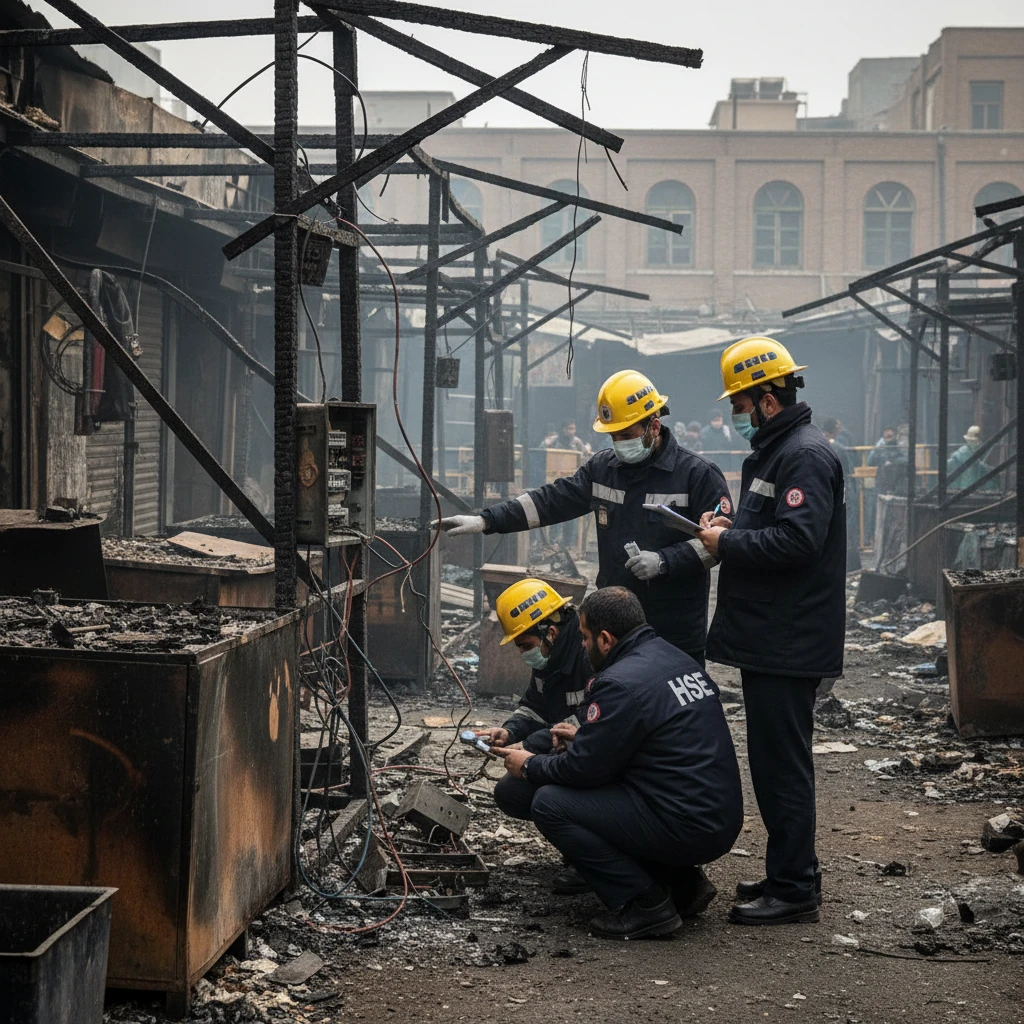
HSE Investigation into Jannat Abad Market Fire Identifies Electrical Safety Failure as Cause
The Deputy for Prevention and Protection of the Tehran Fire Department announced the final technical and safety findings regarding the large‑scale fire at Jannat Abad Market, identifying deficiencies in electrical safety and non‑compliance with HSE requirements as the primary cause of the incident.
According to ISNA, on Tuesday last week a major fire broke out at Jannat Abad Market in western Tehran. The market, covering an area of approximately 5,000 square meters and comprising 253 commercial stalls, was completely engulfed by the fire. Fortunately, the incident resulted in no fatalities, but it caused extensive financial damage and seriously threatened the livelihoods of hundreds of shopkeepers.
Kamran Abdoli, Deputy for Prevention and Protection of the Tehran Fire Department, stated in an interview with ISNA that following the full containment of the fire, specialized teams from the Fire Department initiated a comprehensive investigation using a risk assessment and root cause analysis approach.
These investigations included analysis of the fire remains, on‑site field observations, review of videos and photographs recorded by shopkeepers and the site guard, footage from surveillance cameras of nearby construction projects, interviews with individuals present at the scene, examination of case records, and expert opinions from operational units and the Department of Prevention, which convened immediately after the incident.
He added:
based on the final assessment, the fire origin was identified, and the main cause of the fire was determined to be an electrical short circuit in the market’s wiring system, which rapidly spread to adjacent stalls due to the absence of adequate safety and protective systems.
HSE Warning and Preventive Requirements
Emphasizing the importance of compliance with HSE principles in public and commercial facilities, Abdoli noted that
the lack of periodic electrical safety inspections, use of non‑standard equipment, high density of stalls, and absence of appropriate fire detection and suppression systems are among the factors that can significantly increase the severity of similar incidents.
He emphasized that:
regular electrical safety inspections, safety and fire‑prevention training for shopkeepers, installation of fire alarm and suppression systems, and continuous monitoring of HSE compliance play a decisive role in preventing high‑risk incidents and reducing human and financial losses.
This incident once again highlights the urgent need for serious attention by urban managers, property owners, and operators of commercial facilities to Health, Safety, and Environment (HSE) management, as neglect in this area can lead to severe economic and social consequences.
- source:https://www.isna.ir/
- author:DGS
- 1404/11/19