
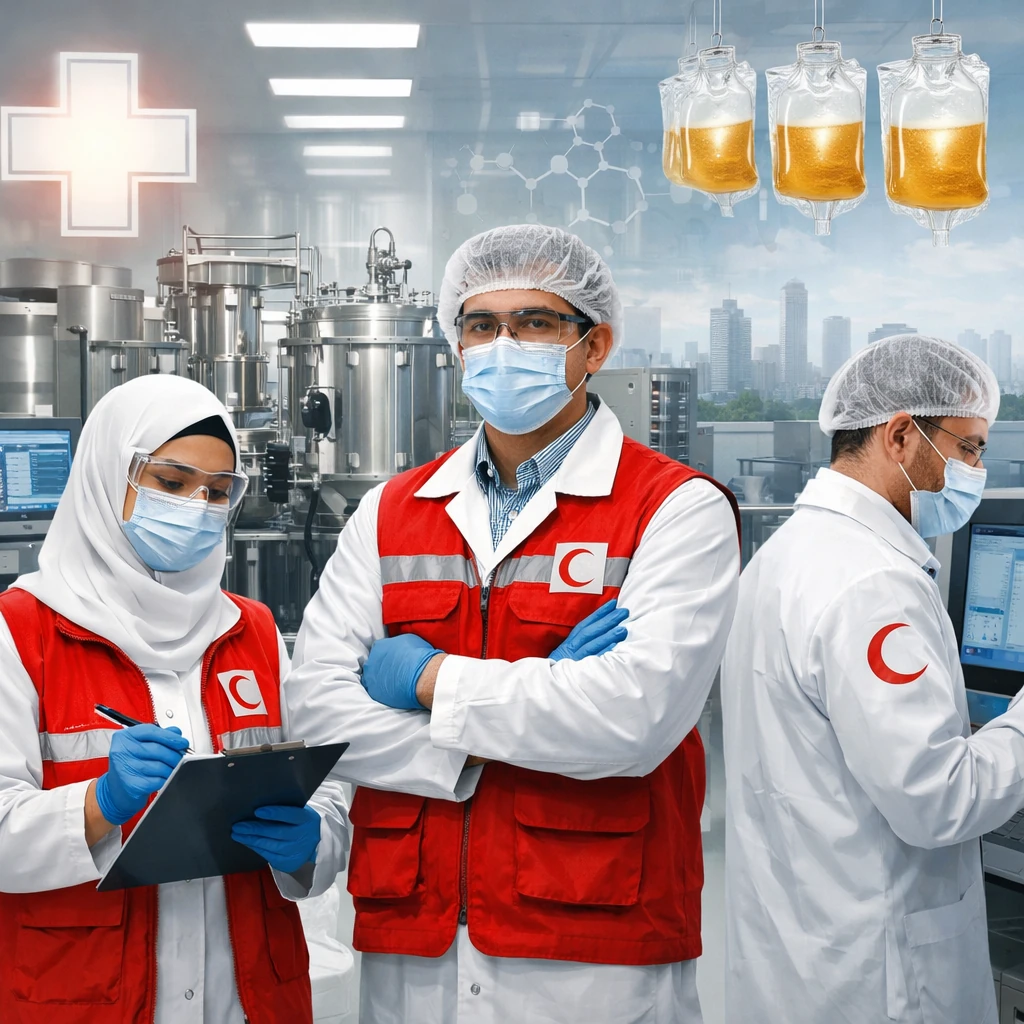
Enhancing Safety and Resilience in the Health System Iranian Red Crescent’s Strategic Entry into Blood Plasma Fractionation and Plasma‑Derived Drug Production with an HSE‑Centered Approach
The President of the Iranian Red Crescent Society (IRCS) announced the initiation of plans to establish a blood plasma fractionation plant and to enter the production of plasma‑derived medicines, describing the move as a strategic step toward strengthening biosafety, improving public health standards, reducing supply‑chain risks, and enhancing national health system resilience.
Speaking at the closing ceremony of the annual meeting of IRCS CEOs and senior executives, Pirhossein Kolivand stated that over the past year, the Red Crescent has evolved from a purely reactive organization into a forward‑looking, technology‑driven institution grounded in risk management and HSE principles (Health, Safety, and Environment) across all its missions.
🔹 HSE as the Unifying Framework for Relief, Health, and Medical Operations
Kolivand noted that the year 1404 (2025–2026) was marked by overlapping crises and heightened risks, including natural disasters, extreme weather events, mass gatherings, cross‑border missions, and security threats.
He emphasized that managing such complexity required a systematic HSE approach, ensuring the safety of responders, protection of public health, and minimization of environmental impacts.
🔹 Prevention and Risk Reduction: From Public Education to Traffic Safety
Highlighting preventive initiatives, Kolivand referred to programs such as traffic behavior improvement campaigns, injury‑reduction initiatives during high‑risk events, and volunteer‑based community education. These measures were designed to reduce preventable incidents and strengthen a culture of safety at the societal level.
🔹 80% Growth in Nowruz Services While Maintaining Responder Safety
Despite an 80 percent increase in the volume of Nowruz relief and support services compared to the previous year, Kolivand stressed that enhanced safety protocols, continuous training, and operational monitoring ensured that the health and safety of both responders and the public remained the top priority.
🔹 Crisis Management with a Focus on Safety and Mental Health
Addressing incidents such as the Bandar Shahid Rajaee explosion, the crash of a rescue helicopter, and various security‑related challenges, Kolivand underlined that effective crisis response extended beyond field operations to include psychological safety, stress management for personnel, and responsible public communication, reflecting the organization’s growing institutional maturity.
🔹 HSE in Mass Gatherings and International Missions
Regarding operations during Arbaeen, Hajj, and other large‑scale religious gatherings, Kolivand noted that integrated health management, disease prevention, environmental safety, crowd‑risk assessment, and rapid medical response systems were implemented to safeguard millions of participants.
🔹 Strategic Entry into the Health Sector: Biosafety and Pharmaceutical Security
In the final part of his remarks, Kolivand emphasized that the decision to establish a plasma fractionation facility and produce plasma‑derived medicines is not merely an industrial initiative, but a core biosafety and health‑security project.
He explained that the initiative aims to:
- Reduce dependency on imported life‑saving medicines
- Mitigate risks arising from pharmaceutical and banking sanctions
- Upgrade biosafety standards in plasma processing
- Ensure sustained access for patients with chronic and rare diseases
- Strengthen the resilience of the national health system
.....
🔹 Technology, Smart Systems, and HSE Integration
Kolivand highlighted that the deployment of rescue drones, artificial intelligence, big‑data analytics, and robotic technologies has not only accelerated operations but also significantly reduced risks to human responders and enhanced overall operational safety.
🔹 Conclusion
Kolivand concluded that the Iranian Red Crescent is no longer solely an emergency response organization, but a national reference point for safety, health, and crisis management. The future of humanitarian response, he noted, lies in the balanced integration of humanity, technology, and HSE—an approach that positions the Red Crescent to respond effectively to the complex crises of the future.
- منبع:ایسنا
- author:DGS
- 1404/11/26