
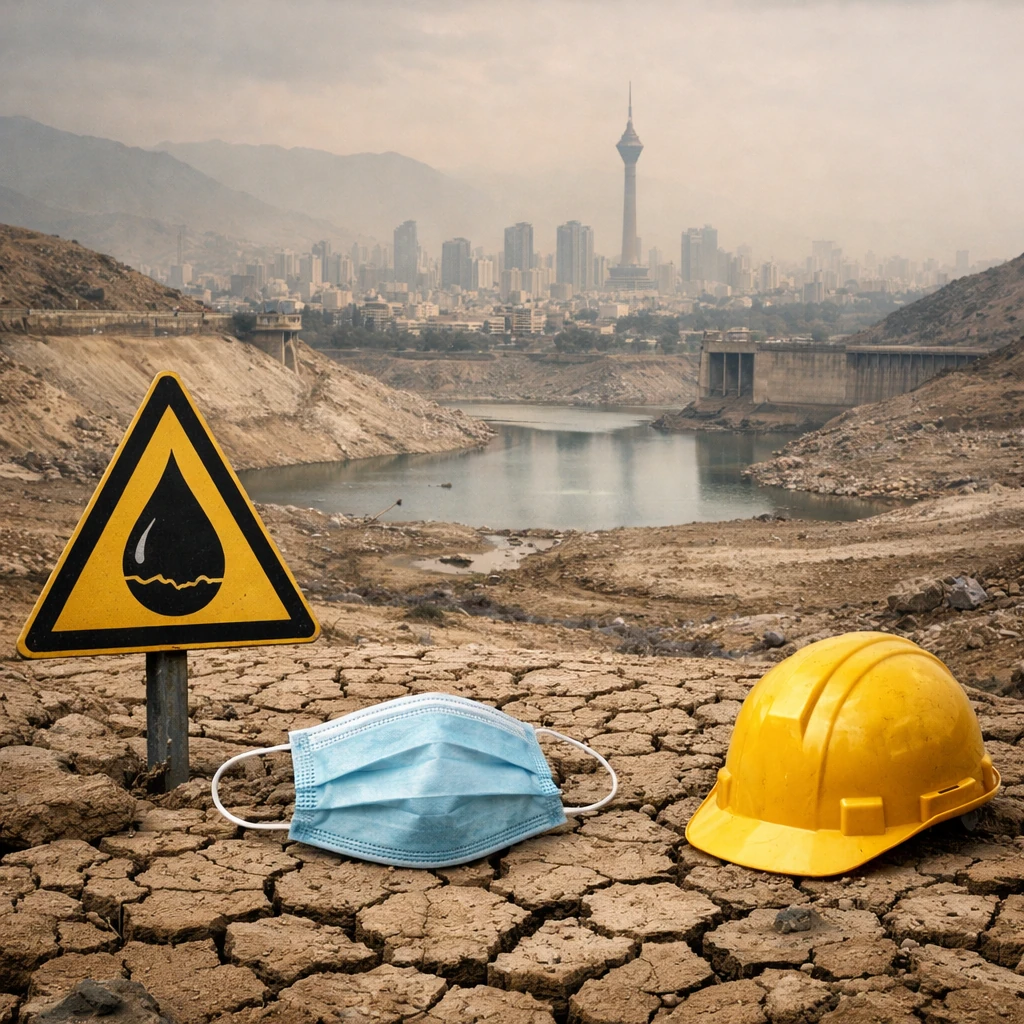
Tehran’s Water Crisis from an HSE Perspective: A Combined Threat to Health, Safety, and Urban Sustainability
Tehran is experiencing one of its most severe water shortages in decades, as the city’s main dams have reached their lowest storage levels in fifty years and experts warn about the risk of a potential “Day Zero.” Diminishing rainfall, persistent drought, and above-average consumption have placed the metropolis at the center of a compounded crisis affecting public health, urban safety, and environmental balance.
The five major dams supplying Tehran—Amir Kabir, Latian, Lar, Taleqan, and Mamloo—are now operating with less than five percent of their full capacity. According to official data, precipitation during the first five months of the current hydrological year has fallen below 80 millimeters, a significant deficit compared to the long-term average. Seasonal household water use, particularly during pre–New Year cleaning, is adding additional pressure to the already strained distribution network.
From an HSE (Health, Safety, and Environment) standpoint, Tehran’s water crisis is not merely an issue of natural resources; it directly affects public health and urban safety. Lower reservoir levels and reduced network pressure increase the risk of contamination and backflow within the city’s water supply, while the concentration of pollutants in surface and groundwater sources may lead to renal and metabolic disorders. Moreover, the over-extraction of groundwater has intensified land subsidence, endangering buildings and critical infrastructure such as gas pipelines, subway tunnels, and roads.
Average water consumption in Tehran has reached 195 liters per person per day, far exceeding the recommended 130-liter benchmark. Although more than one million water-saving devices have been installed in residential units, a significant portion of the population still consumes beyond sustainable limits. If this trend continues, the city’s water distribution resilience may fall critically low, jeopardizing stable water supply during the hottest months of the year.
HSE experts believe that the ongoing crisis stems from a combination of mismanagement, climate change, and unsustainable consumption behavior. Overcoming these challenges requires more than individual conservation—it demands intelligent water governance that fully integrates health, safety, and environmental considerations into municipal policymaking.
Key strategies to mitigate the crisis include developing urban HSE-driven water management programs, utilizing smart monitoring systems for leak detection and water quality, expanding greywater recycling in residential and healthcare facilities, educating the public on safe and sustainable consumption, and reforming industrial water-use policies under ISO 14001 and 45001 frameworks.
If the current trajectory continues, Tehran’s water security will face a broader sustainability crisis, bringing not only water scarcity but also public health risks, infrastructural damage, and a decline in overall quality of life. Today, Tehran stands at a critical crossroads where the future of its health, safety, and environment depends on decisions made now. Only through responsible consumption patterns, smart technology adoption, and shared commitment between citizens and authorities can the city prevent its water crisis from turning into a humanitarian and environmental disaster.
author:DGS
source:https://www.mehrnews.com/