
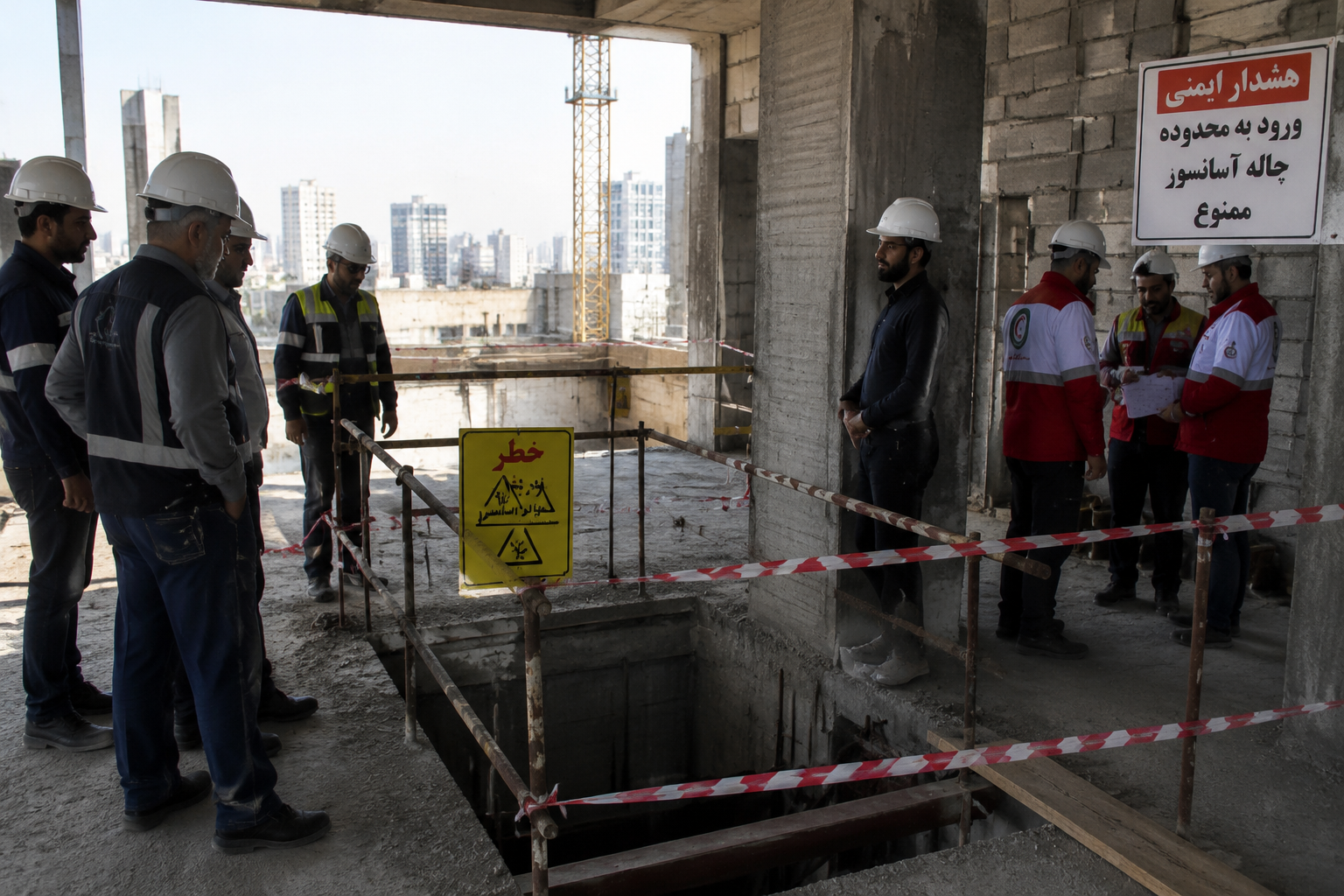
Failure to Secure Elevator Shaft Causes Fatal Accident; Death of Construction Worker in Shiraz Raises Serious HSE Concerns
Shiraz – Following a workplace accident at a building under construction in Shiraz, a construction worker lost his life after falling into an elevator shaft—an incident that once again underscores the critical importance of complying with Health, Safety, and Environment (HSE) requirements in construction projects.
According to the Supporters of Occupational Health and Safety News Agency, quoting the Iranian Labour News Agency (ILNA), the worker was engaged in construction activities on the sixth floor of a building under development when, due to the absence of proper protective barriers and failure to observe working-at-height safety principles, he fell approximately 15 meters to the bottom of the elevator shaft.
Initial reports indicate that the victim was around 50 years old. The injuries sustained were so severe that he died before being transferred to a medical center.
The Need to Reassess HSE Requirements in Construction Projects
This incident occurred while elevator shafts, exposed edges, temporary stairways, and open voids in unfinished buildings are widely recognized as among the most significant hazards in construction sites. HSE experts emphasize that leaving elevator shaft openings unprotected and without durable physical barriers is a clear example of unsafe site conditions and can lead to fatal and irreversible accidents.
In many construction projects—particularly during structural, masonry, and installation phases—the elevator shaft area becomes one of the most dangerous zones for workers, technical staff, and even unauthorized persons due to the lack of safe and permanent barriers. This is despite the fact that, according to safety principles, all open voids and fall hazards must be fully blocked off or secured using rigid, durable, fixed, and reliable protective measures.
Warning Tape Is Not a Substitute for Physical Protection
Field observations and the experience of similar incidents show that the use of warning tape, rope, lightweight barriers, or temporary caution markers is by no means sufficient to secure elevator shaft openings. Such measures serve only as visual warnings and cannot physically prevent falls. For this reason, safety professionals recommend that elevator entrances in buildings under construction—or in complexes where elevators have not yet been installed and commissioned—must be blocked using temporary metal doors, solid panels, fixed guards, or other robust protective structures.
Responsibility of Employers, Owners, and Project Managers in Preventing Accidents
Occupational safety specialists believe that preventing similar incidents requires continuous supervision by employers, contractors, property owners, and project managers to ensure the implementation of HSE procedures. Identifying hazardous areas, conducting risk assessments, continuously training workers, installing standard warning signage, using collective and personal protective equipment, and carrying out regular safety inspections are among the measures that must be seriously pursued in all construction projects.
The following actions can also play a significant role in reducing the risk of similar accidents:
- Installing fixed and durable protective barriers at elevator shaft openings on all floors
- Implementing daily inspection and control systems for high-risk areas
- Training workers on the hazards associated with working at height
- Using personal protective equipment appropriate to the nature of the task
- Preventing unnecessary access to unsafe areas
- Requiring subcontractors to comply with approved safety procedures
A Wake-Up Call for Safety Culture on Construction Sites
The occurrence of such incidents indicates that, in some construction projects, safety is still not treated as a fundamental and non-negotiable requirement. This is despite the fact that compliance with HSE principles not only prevents loss of life, but also improves productivity, reduces project delays, prevents legal consequences, and protects human capital.
The tragic incident in Shiraz once again highlights the fact that negligence in securing high-risk areas—especially elevator shafts—can, within moments, result in the loss of a worker’s life. This further reinforces the urgent need to strengthen a culture of prevention and safety accountability across construction sites throughout the country.
- source:HSENK
- author:DGS
- 1405/03/23