
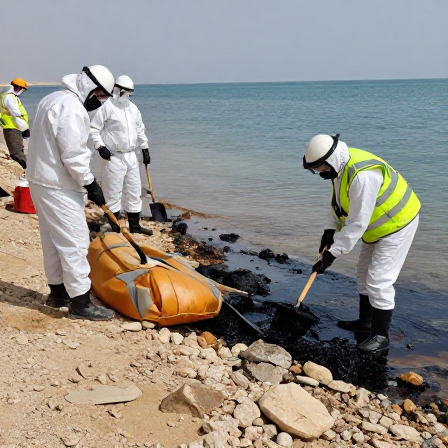
HSE-Focused Monitoring and Cleanup of Oil Pollution on Shidvar Island Coast Intensified
The Deputy for Marine Environment and Wetlands at Iran’s Department of Environment announced the continuation of specialized monitoring and field operations aimed at controlling, reducing, and cleaning up oil pollution in the coastal waters of Shidvar Island, emphasizing the need to strengthen HSE requirements, protect sensitive marine ecosystems, and enhance operational preparedness under crisis conditions.
According to Hamiyan Salamat va Imenei Nirooye Kar News Agency, quoting the Public Relations Office of the Department of Environment, Ahmadreza Lahijanzadeh stated that oil slicks entered the coastal waters of Shidvar Island following explosions in oil storage tanks on Lavan Island caused by hostile enemy actions during the imposed war. As a result, parts of the marine environment and coastal strip in the area were affected by oil contamination.
He added that through prompt response measures, inter-agency coordination, and cooperation with the Iranian Offshore Oil Company, portions of Shidvar Island’s coastline have been cleaned of oil pollution. In other sections, the level of contamination has significantly decreased due to the natural evaporation of petroleum compounds, strong winds, dispersion of the slicks, and the environment’s natural self-purification capacity.
Ongoing Environmental Monitoring in the Persian Gulf and the Sea of Oman
The Deputy for Marine Environment and Wetlands stressed the continuity of environmental surveillance across southern marine zones of the country, stating that continuous monitoring in the Persian Gulf and the Sea of Oman is underway to detect any possible pollution through the use of satellite imagery, expert assessments, and ongoing observation of sensitive coastal and marine areas.
He noted that these monitoring efforts were not halted even during wartime and have remained one of the main pillars of environmental crisis management.
Oil Pollution Management as a Key Component of HSE Requirements in Crisis Conditions
Referring to oil pollution incidents in the Persian Gulf resulting from attacks on oil facilities, Lahijanzadeh said that during the imposed war, several incidents led to the release of oil slicks into the Persian Gulf, each posing a serious threat to environmental safety, ecosystem health, biodiversity, fisheries activities, aquatic species, marine birds, and the environmental security of the country’s coastlines.
He continued: one such case involved the spread of oil slicks around Khark Island. In that instance, the movement of the slicks was first tracked using satellite imagery so that, if they moved toward the coast of Bushehr Province, the necessary measures could be taken by the Ports and Maritime Organization to control, contain, and mitigate the impacts of the pollution in the shortest possible time.
The Need to Protect Sensitive Ecosystems and Strengthen Emergency Response Preparedness
The deputy head of the Department of Environment underlined the importance of sensitive marine areas and environmentally significant islands, stating that Shidvar Island, as one of the country’s valuable and ecologically sensitive habitats, holds particular importance in terms of biodiversity, aquatic life, marine birds, and the ecological balance of the region. Therefore, any oil pollution in this area must be managed through a preventive, expert-driven approach based on Health, Safety, and Environment (HSE) principles.
He added that under such circumstances, rapid action for risk assessment, containment of the pollution source, shoreline cleanup, continuous monitoring, reduction of hazards to operational personnel, and prevention of further spread of contamination ranks among the top priorities of executive and emergency response agencies.
Appreciation for the Cooperation of Responsible Organizations in Oil Pollution Response Operations
Lahijanzadeh also praised the effective actions and cooperation of the Ports and Maritime Organization and the Iranian Offshore Oil Company in monitoring, controlling, and cleaning up some of the oil pollution in the Persian Gulf. He said that synergy among responsible institutions, the use of expert capacities, and the coordinated implementation of field operations have played an important role in reducing the environmental consequences of these incidents on the country’s marine ecosystems.
He expressed hope that with the stabilization of the ceasefire, broader field operations for the accurate identification of pollution hotspots, assessment of environmental damage, rehabilitation of affected areas, and restoration of natural conditions in sensitive coastal and marine ecosystems could begin more rapidly and on a wider scale.
Emphasis on a Preventive Approach and Strengthening HSE Infrastructure
In closing, the Deputy for Marine Environment and Wetlands emphasized that strengthening monitoring infrastructure, improving operational preparedness, upgrading marine pollution response equipment, training specialized personnel, and establishing an integrated HSE system in coastal and offshore industries and facilities are among the most important requirements for reducing damage from similar incidents in the future.
- source:HSENK
- author:DGS
- 1405/03/23