
Elevating National HSE Standards Hinges on a Scientific Approach to Air Pollution Control; Bridging Academia and Industry to Safeguard Public Health
In a joint government-academia consultative assembly, the Head of Iran’s Department of Environment highlighted air pollution mitigation as a paramount priority within public health and environmental protection (HSE), underscoring the vital role of scientific modeling, vehicle fleet modernization, and clean energy deployment.
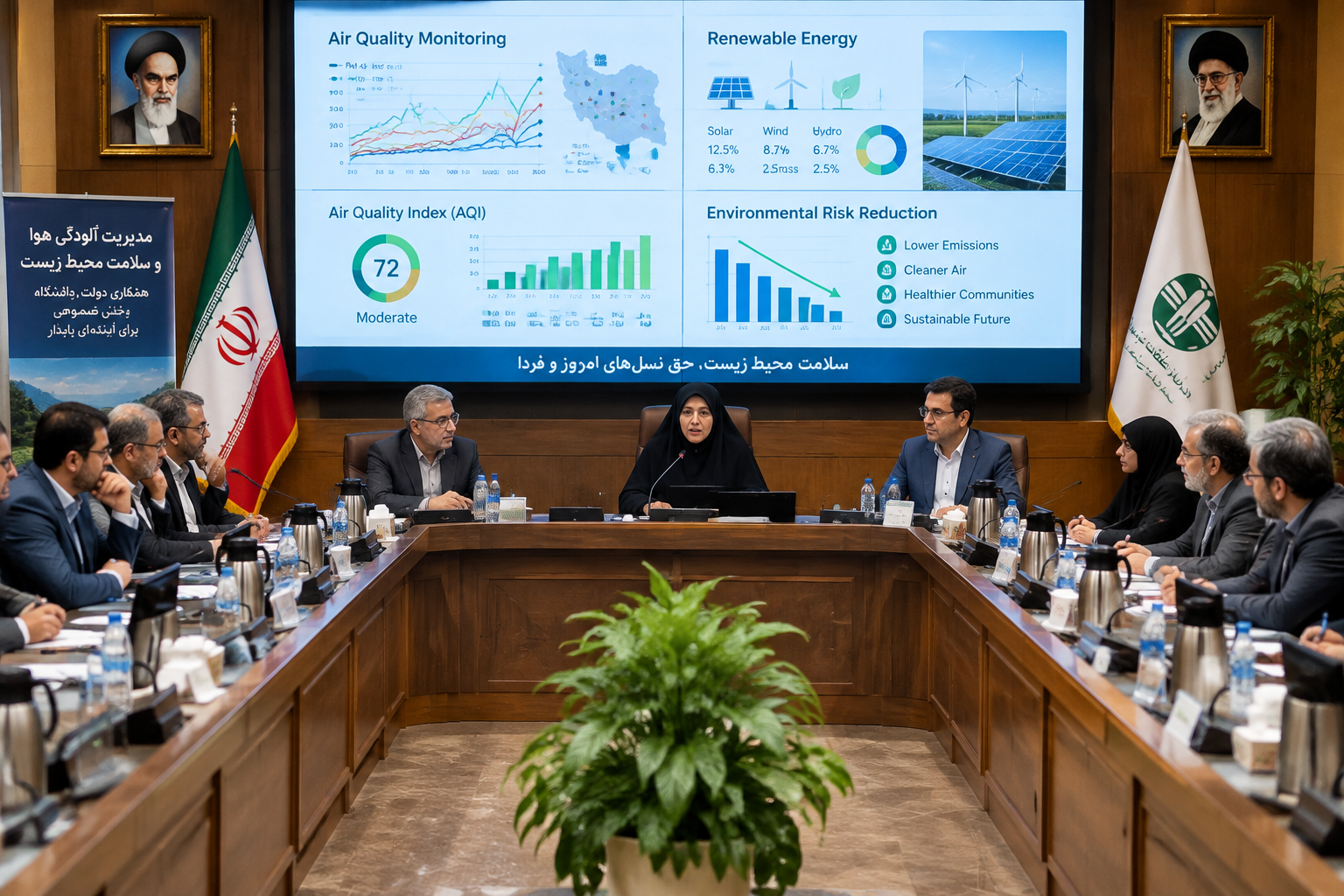
According to the Workforce Health and Safety News Agency, citing the Public Relations Office of the Department of Environment (DOE), the joint collaborative working group of government and academia for scientific air pollution management convened this morning (Monday). The session was hosted by the Department of Environment, attended by Shina Ansari, Vice President and Head of the Department of Environment; Yousef Hojjat, President of Tarbiat Modares University and Head of the Joint Working Group; alongside distinguished scholars and faculty members in environmental engineering and occupational health.
Bridging Academic Expertise with Macro-Level HSE Policy Decisions
Addressing the panel, Shina Ansari commended the active contribution of academic experts, characterizing air pollution as one of the country’s most critical environmental super-challenges directly imperiling public health. She stated: “Establishing a knowledge-based perspective grounded in health risk assessment is an indispensable imperative for environmental governance. The Department of Environment views specialized academic consultancy as a strategic pillar for executive decision-making.”
Referencing the 2024 social survey conducted by the Presidential Office, she remarked: “The public’s decisive demand for clean air reinforces our institutional duty to improve environmental indicators. Acknowledging the multi-dimensional nature of this issue, combined with drawing upon successful models of state-university partnerships in water resource management, constitutes our strategic roadmap for abating atmospheric pollutants.”
Mitigating Environmental Health Risks: From Clean Fuel Deployment
Addressing prevailing headwinds such as energy imbalances and economic sanctions, the Vice President stated: “Despite these constraints, proactive HSE preventive mechanisms have remained steadfast. A prime initiative was the supply of approximately 420 million liters of low-sulfur heavy fuel oil (mazut) over the past year to thermal power plants situated near major population centers. Applying this fuel at the Shazand Power Plant contributed to reducing high-sulfur dioxide ( ) pollution days in the metropolis of Arak from 28 days in 2024 to just 2 days in 2025, marking a substantial reduction in acute respiratory and occupational health risks for citizens.”
She further emphasized the phase-out of mobile emission sources, adding: “Over the past two years, approximately 650,000 dilapidated vehicles have been decommissioned. Concurrently, targeted regulatory amendments to Article 10 of the Automotive Industry Organization Act have provided robust incentive frameworks to accelerate vehicle scrappage and fleet renewal.”
Fleet Decarbonization, Enhanced Technical Inspections, and Stringent Industrial Benchmarks
Ansari highlighted the core action plans targeting mobile emission sources:
- Heavy-Duty and Freight Fleet Revitalization: Decommissioning and replacing commercial tractors and heavy trucks over 50 years of age via energy-saving certificate mechanisms.
- Urban and Commercial Fleet Electrification: Integrating electric and hybrid vehicles into municipal and ridesharing platforms, alongside the replacement and decommissioning of 20,000 obsolete carbureted motorcycles with standardized electric models.
- Mandatory Technical Compliance and Quality Audits: Mandating catalytic converter certifications, enforcing end-of-line vehicle emission verification audits at manufacturing facilities, and unifying national vehicular technical inspection data through digital e-governance infrastructures.
400% Surge in Renewable Energy Capacity: Driving Decarbonization and Green Economy
The Head of the Department of Environment described the transition to renewable resources as a foundational solution for cutting industrial carbon footprints, announcing: “The national renewable power capacity surged from approximately 1,200 MW in early 2024 to nearly 6,000 MW, delivering a vital reduction in fossil-fuel dependency and industrial greenhouse gas emissions.”
Strategic Alignment and Prioritization Without Organizational Redundancy
Reflecting on the resolutions adopted across 14 sessions of the National Working Group for Air Pollution Reduction under the 14th Administration, Ansari underscored: “Proposed strategies formulated by academic panels must be framed into short-term, mid-term, and long-term milestones, prioritizing high-impact, cost-effective measures based on reliable emission inventories—fully implemented within statutory mandates without duplicating bureaucratic structures.”
Concluding her remarks, she emphasized: “Resolving entrenched environmental challenges requires phased, metric-driven execution, continuous indicator monitoring, and seamless synergy among regulatory agencies, universities, and industrial sectors to uphold the public’s fundamental right to a safe, sustainable, and healthy environment.”
- source:HSENK
- author:DGS
- 1405/06/18