
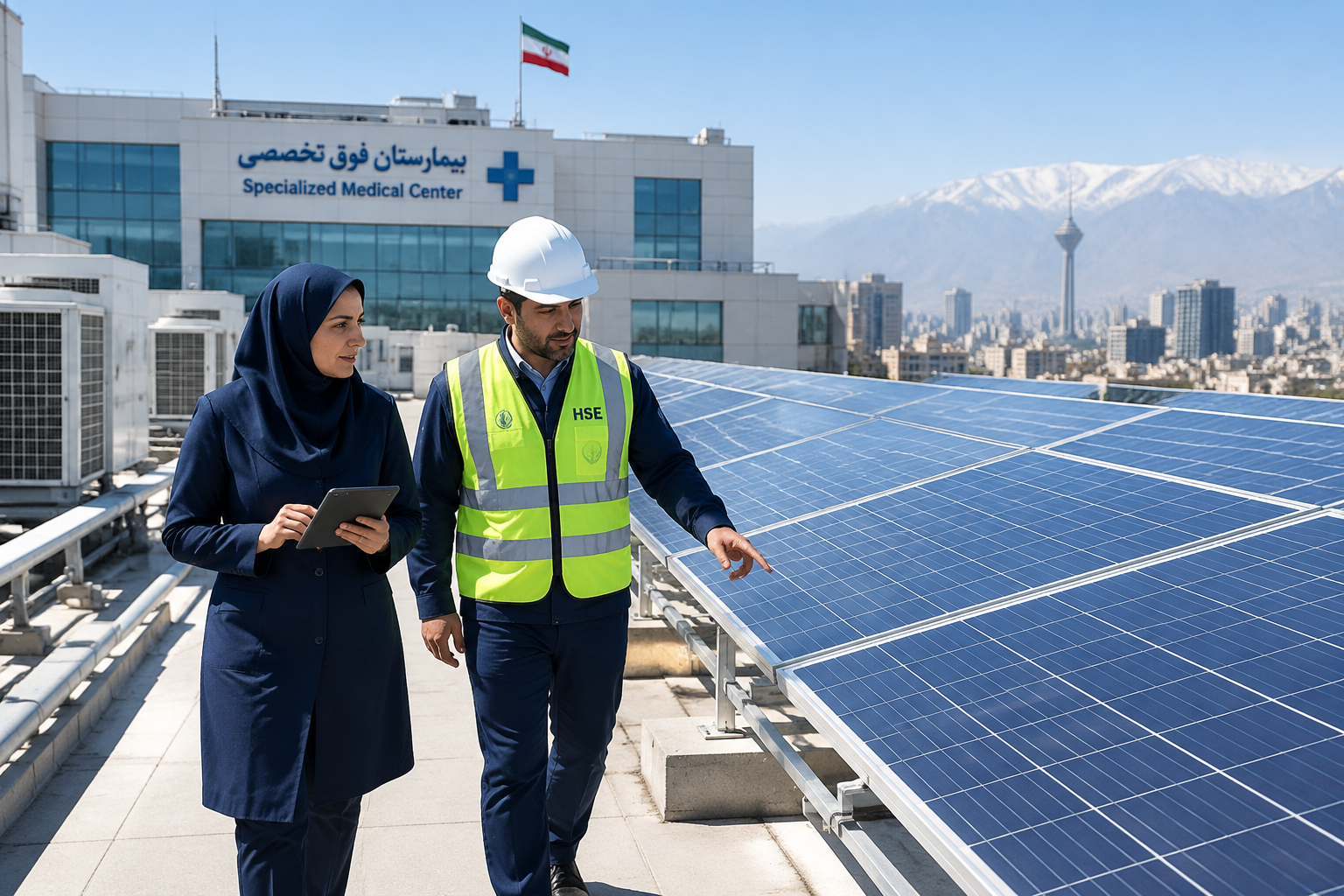
Renewable Energy Deployment: A Strategic Imperative for Environmental Risk Management and Energy Resilience in Healthcare
A Step Toward “Green Hospitals” and Enhancing Passive Defense in Healthcare Infrastructure Attended by the Minister of Health and Medical Education, the Bazarganan Hospital Solar Power Plant and Specialized Clinics were officially inaugurated in alignment with HSE standards and Corporate Social Responsibility (CSR).
TEHRAN – Occupational Safety and Health Advocates News Agency (Quoting WebDa):
The official commissioning ceremony of the photovoltaic (PV) solar power plant and the expansion projects of specialized clinics at Bazarganan Hospital in Tehran was held in the presence of Dr. Mohammad-Reza Zafarghandi, Minister of Health and Medical Education, board members, healthcare philanthropists, senior executive directors, and HSE specialists. The project has been executed with the primary objectives of reinforcing infrastructural resilience, implementing passive defense principles for reliable emergency power supply, and reducing the carbon footprint across the healthcare sector.
Direct Nexus Between Environmental Sustainability and Public Health
Addressing the ceremony, Dr. Mohammad-Reza Zafarghandi emphasized the imperative shift from a purely “reactive treatment” framework toward a “preventive and environmental protection” paradigm, stating:
“The mission and social responsibility of the healthcare system extend far beyond inpatient and clinical services. Holistic protection of public health necessitates active environmental hazard control, safety education, proactive risk prevention, and comprehensive crisis preparedness.”
Highlighting air pollution as one of the country’s most severe environmental health and epidemiological challenges, the Minister added:
“The figures are alarming: air pollution and airborne particulate matter claim the lives of more than 50,000 citizens nationwide each year and over 700,000 children globally. Thus, controlling emission sources and transitioning toward renewable energy are decisive public health mandates. With more than 300 sunny days annually, Iran holds exceptional potential for the widespread deployment of solar energy harvesting systems.”
Energy Imbalance, Crisis Management, and Healthcare Resilience (Passive Defense)
Addressing the current power grid imbalances and their direct implications for the operational safety of sensitive medical equipment, Dr. Zafarghandi underscored:
“Hospitals and healthcare centers are critical energy consumers where even momentary power fluctuations or outages can pose life-threatening risks to patients in Intensive Care Units (ICUs, CCUs) and operating theaters. Expanding rooftop solar installations on healthcare facilities not only fulfills environmental commitments—such as greenhouse gas (GHG) emission mitigation—and peak load management, but also acts as a vital pillar of passive defense, guaranteeing internal grid stability during emergencies.”
Patient Satisfaction and Synergistic Management in Quality and Safety Frameworks
Commending the integrated performance of the hospital’s management, medical personnel, and safety/engineering divisions, Dr. Zafarghandi noted:
“Achieving a 95% patient satisfaction rating reflects a parallel commitment to elevating clinical excellence, adhering to stringent patient safety protocols, and respecting patient dignity. This milestone demonstrates that cross-sectoral synergy coupled with the active engagement of philanthropists can deliver optimal efficiency and the highest standards of care.”
Technical Specifications and the “Green Hospital” Model Implementation
According to the technical brief presented at the event, the on-grid photovoltaic solar power system at Bazarganan Hospital was engineered and commissioned with a nominal capacity of 150 kW, representing a total investment of 60 billion IRR (6 billion Tomans).
Mounted on the facility’s rooftops utilizing high-efficiency panels, key objectives of the installation include:
- Feeding sustainable baseload electricity into the hospital’s internal distribution network, thereby reducing strain on the municipal power grid during peak demand hours.
- Mitigating hundreds of tons of carbon dioxide ( ) emissions and airborne pollutants annually, fully complying with ISO 14001 (Environmental Management Systems) standards.
- Decreasing operational runtime and wear on diesel backup generators, significantly mitigating localized acoustic noise and particulate emissions in densely populated urban zones.
- Establishing a benchmark for national hospital accreditation metrics regarding energy efficiency, occupational safety, and the advancement of the “Green Hospital” initiative.
The ceremony concluded with the Minister of Health and Medical Education presenting commemorative plaques to honor the project engineers, healthcare philanthropists, and executive contributors involved in delivering this green infrastructure initiative.
- source:HSENK
- author:DGS
- 1405/06/23