
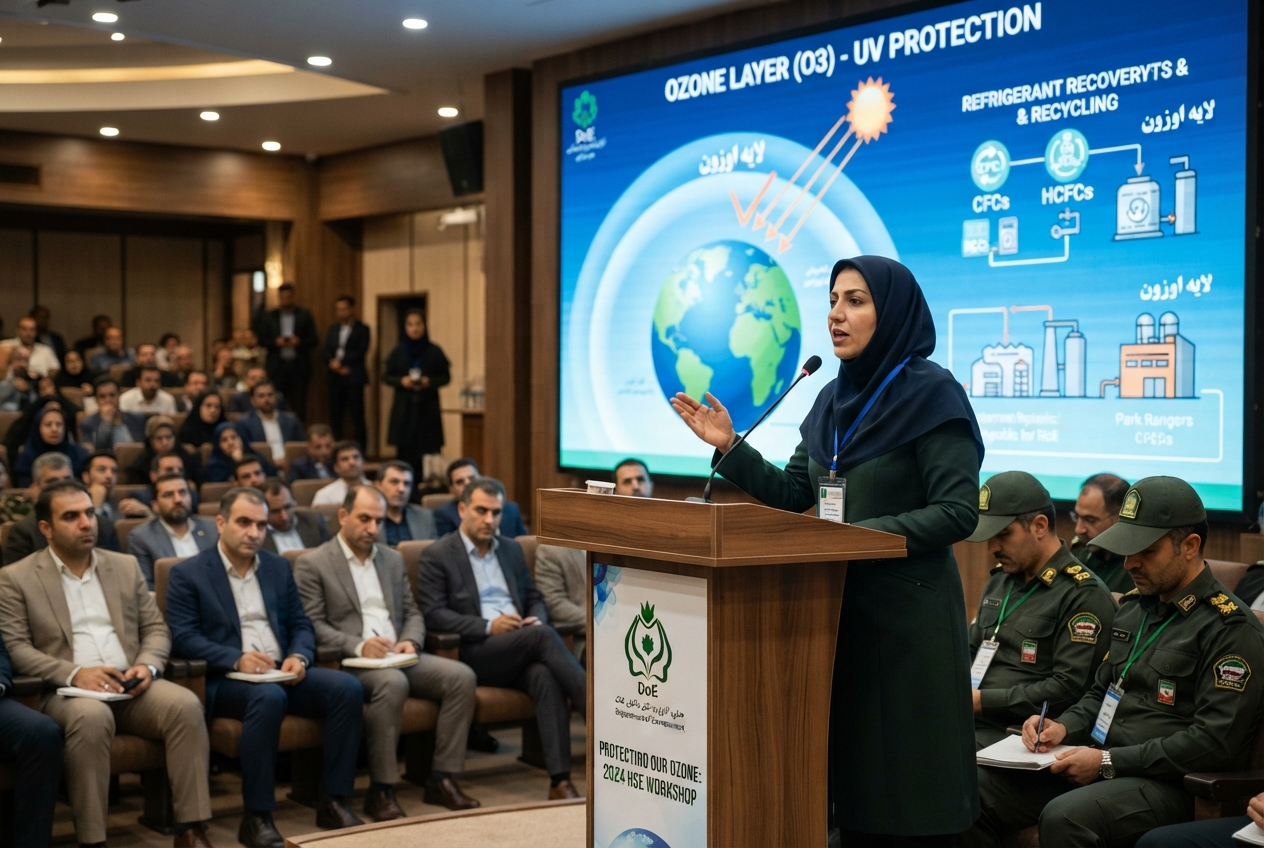
Iran Advances Environmental Monitoring and Bio-Risk Management Benchmarks Under the Montreal Protocol / Focus on Occupational Safety of Park Rangers Against UV Radiation Exposure
TEHRAN – Department of Environment (DOE) News Portal:
Marking the 39th anniversary of the adoption of the Montreal Protocol and World Ozone Day, a high-level symposium under the theme of “Synergizing Safety, Health, and Atmospheric Environmental Management” convened in Tehran on September 15. The event brought together senior officials, including the Vice President and Head of the Department of Environment, HSE directors, representatives of international agencies, specialized NGOs, and leaders from the nation’s cooling and chemical manufacturing industries.
The technical assembly reviewed Iran’s three-decade performance in atmospheric emission controls, occupational and environmental health standards, and the industrial deployment of safe, green, and low-risk technologies.
Structured Environmental Commitments: A Pillar of Public Health and Climate Resilience
Dr. Shina Ansari, Vice President and Head of the Department of Environment, emphasized the treaty’s role as a comprehensive global Environmental Management System (EMS), stating:
“The Montreal Protocol and the Vienna Convention represent far more than legal treaties; they are premier benchmarks of science-based policymaking and environmental risk assessment. The core objective remains the phase-out of Ozone-Depleting Substances (ODS) to safeguard terrestrial ecosystems and mitigate public health hazards associated with carcinogenic Ultraviolet (UV) radiation.”
Underscoring the direct nexus between ozone preservation and climate stabilization, Dr. Ansari highlighted the Kigali Amendment:
“Accelerating the transition from Hydrofluorocarbons (HFCs) toward Low Global Warming Potential (Low-GWP) alternatives, coupled with enhanced energy efficiency across the heating, ventilation, air conditioning, and refrigeration (HVAC&R) sectors, serves as a cornerstone of sustainable development and the mitigation of urban heat loads.”
Addressing the severe environmental footprints left by regional conflicts on infrastructure, fragile habitats, and ranger stations, the Vice President noted that comprehensive environmental stewardship strictly requires sustained peace, regional stability, and robust cross-border HSE infrastructure.
Occupational Health Management for Field Personnel and Controlling Tropospheric Ozone
In another segment of the symposium, Dr. Saeed Mahmoudi, Deputy Head of Human Environment at the DOE, delineated the critical ecological distinction between stratospheric and ground-level ozone:
“While stratospheric ozone serves as a vital planetary shield, tropospheric (ground-level) ozone acts as a hazardous secondary pollutant. Driven by intense solar radiation and photochemical reactions between nitrogen oxides () and Volatile Organic Compounds (VOCs), it poses severe risks to human respiratory systems and biological safety. Controlling volatile chemical precursors remains a top environmental health priority.”
Dr. Mahmoudi further addressed the Occupational Health and Safety (OHS) requirements of frontline field personnel:
“Park rangers and environmental field officers operate under prolonged outdoor exposure to elevated Ultraviolet Index (UVI) levels. Consequently, formulating specific health protocols, upgrading personal protective equipment (PPE), and supplying standardized UV-blocking apparel and ergonomic gear are embedded in our institutional HSE mandates.”
Phasing Out ODS and the Strategic Roadmap for Green Refrigerants by 2028
Dr. Hossein Shahbaz, Deputy Head of Human Environment at the DOE, addressed the technical aspects of chemical substitution programs:
“Iran remains an early adopter and regional leader in phasing out destructive compounds, including Chlorofluorocarbons (CFCs) and Halons. In accordance with mandated timelines leading up to the 2028 milestone, capacity building for the phase-out of HCFCs and the implementation of HFC phasedown frameworks outline our strategic roadmap across industrial, automotive, and building-services sectors.”
Presenting quantitative HSE training and monitoring metrics, he added:
“To standardize industrial handling of chemical refrigerants, over 300 technical workshops, exceeding 22,000 person-hours of process-safety training, have been delivered, certifying hundreds of certified technicians in safe recovery, containment, and sound disposal to eliminate occupational leaks, toxicity risks, and atmospheric venting.”
HSE Operational Strategic Pillars Aligned with Montreal Protocol Goals
Concluding the session, the Department of Environment, in coordination with regulatory and industrial stakeholders, established key HSE action directives:
- Upgrading Chemical Safety Standards: Rigorous oversight on the import, containment, handling, and application of low-risk, natural refrigerants within industrial cooling systems.
- Occupational Health Surveillance for Field Personnel: Implementing mandatory UV-exposure monitoring alongside the deployment of certified UV400-rated protective gear for outdoor environmental staff.
- Enhancing Refrigerant Recovery and Reclamation (RRR): Expanding dedicated recovery stations for hazardous fluorinated gases to prevent uncontrolled atmospheric releases.
- Energy Optimization and Industrial Decarbonization: Enforcing high energy-efficiency compliance across cooling manufacturing lines to minimize lifecycle carbon footprints.
- source:https://www.mehrnews.com/
- author:DGS
- 1405/06/24