
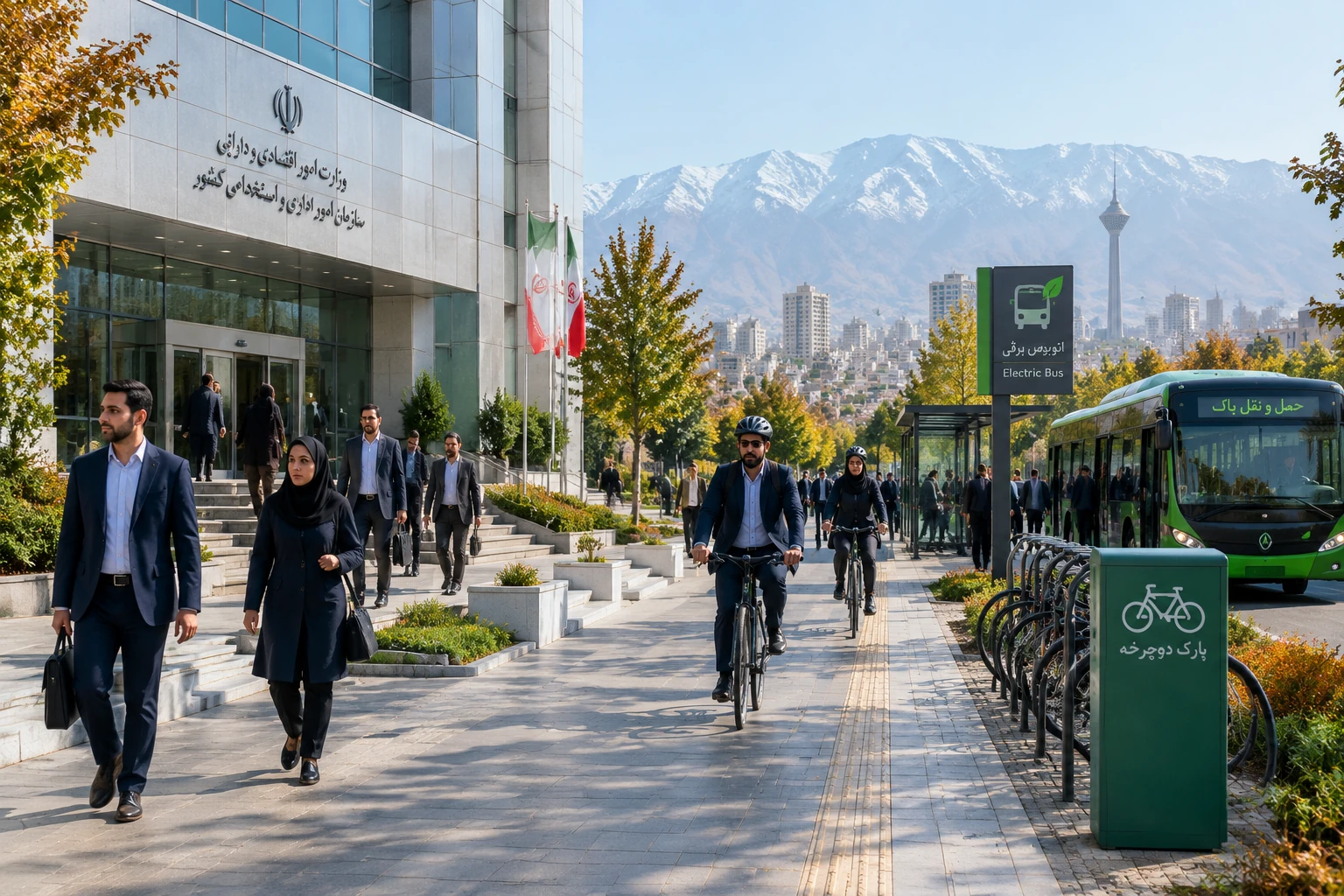
Notification of the National “Clean Organization” Strategy: Government and Municipal Synergy to Mitigate Inversion Hazards and Reduce Corporate Carbon Footprints
Following the presidential executive order and the binding circular issued by the Administrative and Recruitment Affairs Organization of Iran (ARAO), an operational framework for the “Car-Free Day” initiative has been integrated into the preventative environmental agendas of all governmental organizations and public sector institutions. Under this decree, administrative bodies are mandated to phase out single-occupancy private vehicle commutes for their workforce on at least one business day per week through the end of the current fiscal year by deploying viable multimodal transit alternatives.
Dr. Shina Ansari, Vice President and Head of the Department of Environment (DOE), highlighted the biosafety and ecological dimensions of this policy, remarking:
“Initiating this program directly within the governmental apparatus signifies a paradigm shift from passive observation to active risk management in public health governance. The public sector cannot expect voluntary civic collaboration in air pollution abatement without demonstrating an intrinsic institutional commitment to sustainability metrics.”
Strategic Timing Amid Atmospheric Thermal Inversion
From an environmental health engineering perspective, roll-out of this initiative during the second half of the solar calendar year is critical. Annually, atmospheric boundary layer stability (temperature inversion) across industrial and densely populated hubs—including Tehran, Isfahan, Mashhad, Tabriz, and Arak—triggers critical accumulations of toxic fossil-fuel combustion byproducts, specifically fine particulate matter and volatile organic compounds (VOCs).
A major fraction of this emissions burden stems from prolonged reliance on automobile-centric urban design. Over past decades, disproportionate capital allocation toward vehicular corridors, expressways, and grade-separated interchanges has progressively compromised metropolitan airsheds and marginalized pedestrian-oriented, human-centric city planning.
Mandatory HSE Operational Guidelines for Executive Agencies
The official circular underscores that the program’s continuity depends entirely on establishing supporting infrastructure alongside structured HSE management protocols. Corporate HSE departments across public bodies and associated facilities are instructed to execute the following operational measures:
- Corporate Travel Demand Management (TDM) & Commuter Fleet Optimization:Reactivating, standardizing, and optimizing dedicated employee shuttle services to maximize shared-fleet efficiency and minimize urban traffic incident risks.
- Institutional Carpooling Networks:Deploying centralized digital coordination platforms to streamline ride-sharing and carpooling among personnel along overlapping transit corridors.
- Active and Low-Emission Mobility Infrastructure:Allocating secure parking depots and charging stations for zero-emission micro-mobility (bicycles and electric scooters) within administrative compounds, supported by basic end-of-trip amenities to incentivize active commuting.
- Corporate Carbon Footprint Accounting & Auditing:Designated environmental monitoring units must log, calculate, and report monthly reductions in direct greenhouse gas emissions ( CO2CO 2 equivalent) and criteria air pollutants achieved through this protocol.
Transitioning from Symbolic Gestures to Sustainable Organizational Culture
Reflecting on past grassroots initiatives such as “Car-Free Tuesdays,” the DOE Head emphasized:
“Symbolic public campaigns devoid of structural enterprise-level logistics and reliable transit alternatives cannot generate lasting epidemiological or environmental improvements. The present mandate focuses on instilling a permanent institutional norm that bolsters urban ecological resilience. Continuous auditing, mitigating logistical friction for commuters, and parallel fleet expansions by municipal transit authorities remain vital prerequisites for consolidating this behavioral transformation.”
Conclusion and Outlook
The nationwide implementation of this initiative represents an operative step toward enforcing Article 29 of the Clean Air Law and meeting environmental management criteria aligned with ISO 14001 specifications within the public sector. Public sector leadership in demand management and fuel economy rationalization is poised to catalyze broader public adoption, driving systemic restoration of metropolitan air quality nationwide.
- source:HSENK
- author:DGS
- 1405/07/04