
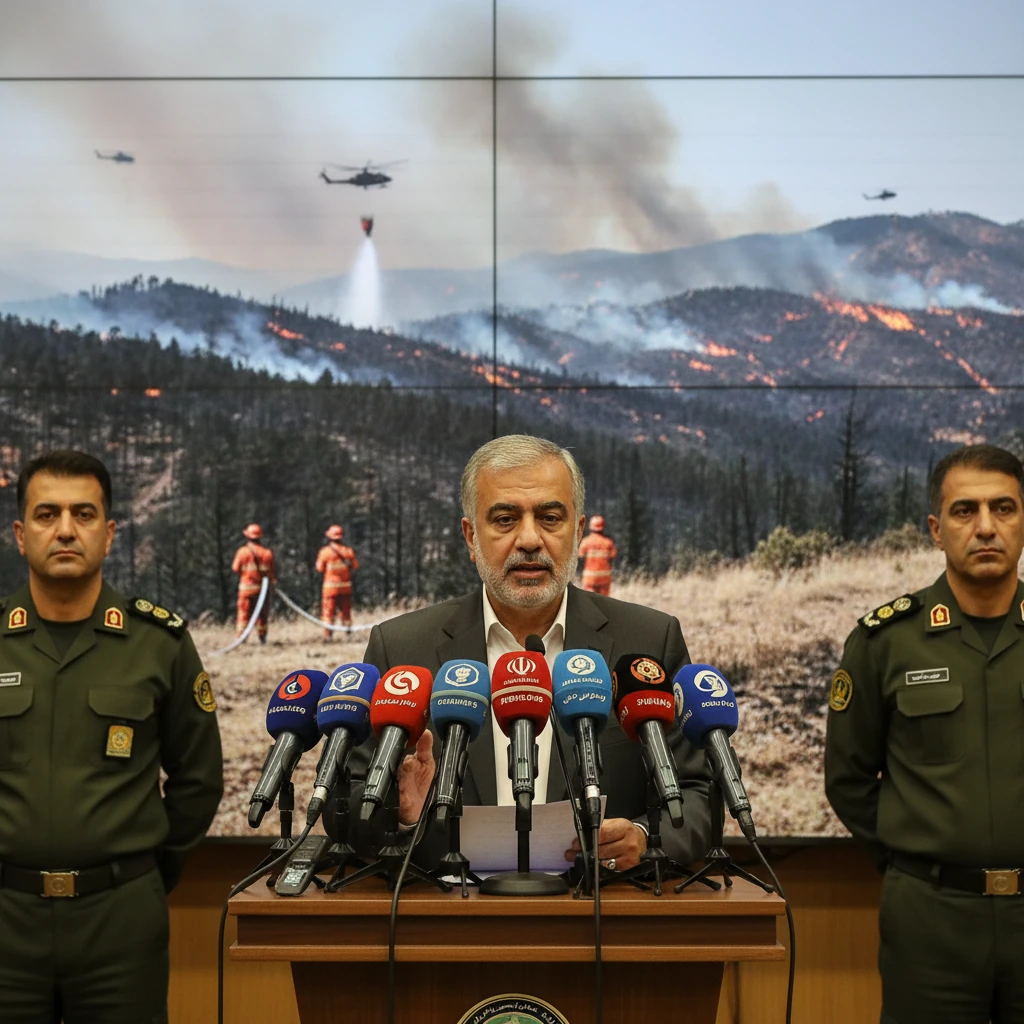
Zohrebi: Parliament’s Report on the Elit Forest Fire Is Unscientific; Efforts of Rangers and Local Communities Were Overlooked
The Deputy Head of Natural Environment and Biodiversity at Iran’s Department of Environment (DOE), strongly criticizing Parliament’s report on the Elit forest fire, described it as contradictory, unscientific, and unfair to the environmental ranger community and local residents. He said attributing the spread of the fire to the lack of permits for collecting fallen trees has no scientific basis, adding that the Department of Environment will not submit to non‑expert decisions.
To report https://www.ilna.ir/Hamid Zohrebi, speaking at a press conference with journalists and referring to the factors contributing to the increase in wildfires in Elit forests and the Zagros region, stated: Fire is one of the factors that can contribute to regulating biodiversity; however, in recent years, persistent droughts and climate change have increased the scale, intensity, and altered the timing of wildfires.
He added that in the past, wildfires in the Zagros region typically began in mid‑June and continued until late September, whereas now this timeframe starts as early as April and can extend into December. Alongside climate change, economic pressure on local communities, illegal exploitation of natural resources, land grabbing, and increased human presence in forests for resource extraction or illegal hunting have made the protection of forests and rangelands far more challenging and have posed more serious threats to the country’s biodiversity.
Explaining the status of protected areas under the Department of Environment, Zohrebi said: Twelve percent of the country’s total area—equivalent to approximately 19.8 million hectares—is managed by this organization. Across this vast area, there are about 650 ranger stations and nearly 4,000 environmental rangers. This field presence has increased the speed of response to wildfires. Our main focus in this field is forecasting, early warning, and prevention.
Referring to the organization’s new approaches to fire management, he emphasized: In sensitive areas—particularly zones largely under the organization’s direct management—the deployment of forces and the active presence of environmental officers have played a key role in the rapid control of fires. Given that fires spread very quickly in mountainous areas, our primary strategy is risk reduction through prevention and preparedness in advance.
Zohrebi described the participation of local communities as one of the main pillars of success in combating wildfires and said: In the Zagros forests, a large part of firefighting operations is carried out with the central involvement of local people. Instead of deploying large numbers of government forces everywhere, our focus has been on identifying local capacities and training local communities. In this regard, a large consultative meeting was held in Lorestan Province with the participation of experienced individuals, and a community‑based, prevention‑oriented plan for managing fires in the Zagros region was developed.
Regarding the use of modern technologies, he stated: In the Hyrcanian forests, due to the difficulty of access, our focus has been on installing cameras and fire‑warning sensors. In addition, in cooperation with a knowledge‑based company, an artificial intelligence–based system has been developed that analyzes data such as temperature, wind speed, and fuel load to predict the likelihood of fire occurrence with an accuracy of 70 to 85 percent.
Zohrebi noted that this system does not identify the exact location of a fire but rather highlights high‑risk zones so that an alert status can be declared in those areas. Experience has shown that the system’s warnings are correct in most cases and have played an important role in the rapid containment of fires, although fires of human origin cannot be fully predicted.
Referring to smart‑management measures in protected areas, he said: Plans to monitor and control fires had been initiated in previous years but were halted for managerial reasons. These systems have now been reactivated and are being upgraded with the help of consultants. One of the organization’s core programs is the smartening of protected areas using tools such as intelligent cameras, human‑animal differentiation, smoke and fire detection, and digital data recording.
Describing a field example of fire management in the Elit forest, Zohrebi explained: In this area, the fire was spreading underground while surface fires appeared to have been controlled. Through timely detection and an expert decision, a firebreak was constructed along an old waterway, and by deploying forces at that point, the advance of the fire was completely halted. Had this decision not been made in time, the area would have faced a widespread fire and heavy damage.
Criticizing Parliament’s report on the incident, he stressed: The report claims that the Department of Environment intensified the fire by not issuing permits to collect fallen trees, whereas this claim is completely unscientific. The report was prepared in a contradictory and non‑expert manner and ignored the round‑the‑clock efforts of rangers and the effective participation of local communities; this constitutes a clear injustice toward the environmental ranger community.
He emphasized that although the head of the Agriculture Commission had visited the area, the final report failed to adequately reflect the field presence of officers, the sacrifices made by rangers, and the real role played by local communities.
Referring to the successful experience of Golestan National Park, the Deputy Head of Natural Environment and Biodiversity said: Academic studies show that despite an increase in the number of fires due to drought and climate change, reliance on public participation has significantly reduced the total area affected by fires. This demonstrates that the presence of local communities during the critical early moments of an incident can be even more effective than government forces.
In closing, Zohrebi pointed to shortages in manpower and equipment and said: According to global standards, there should be one ranger for every 1,000 to 2,600 hectares of land. Even based on the minimum standard, the country needs around 12,000 environmental rangers. Establishing specialized ground and aerial firefighting units, along with standard equipment and trained personnel, is an undeniable necessity, and fortunately, Parliament has also expressed its readiness to help provide such equipment.
Zohrebi stressed that only through a combination of specialized equipment, professional training, and active participation of local communities can the spread of destructive wildfires be prevented and damage to the country’s natural resources minimized.
- source:https://www.ilna.ir/
- author:DGS
- 1404/09/22