
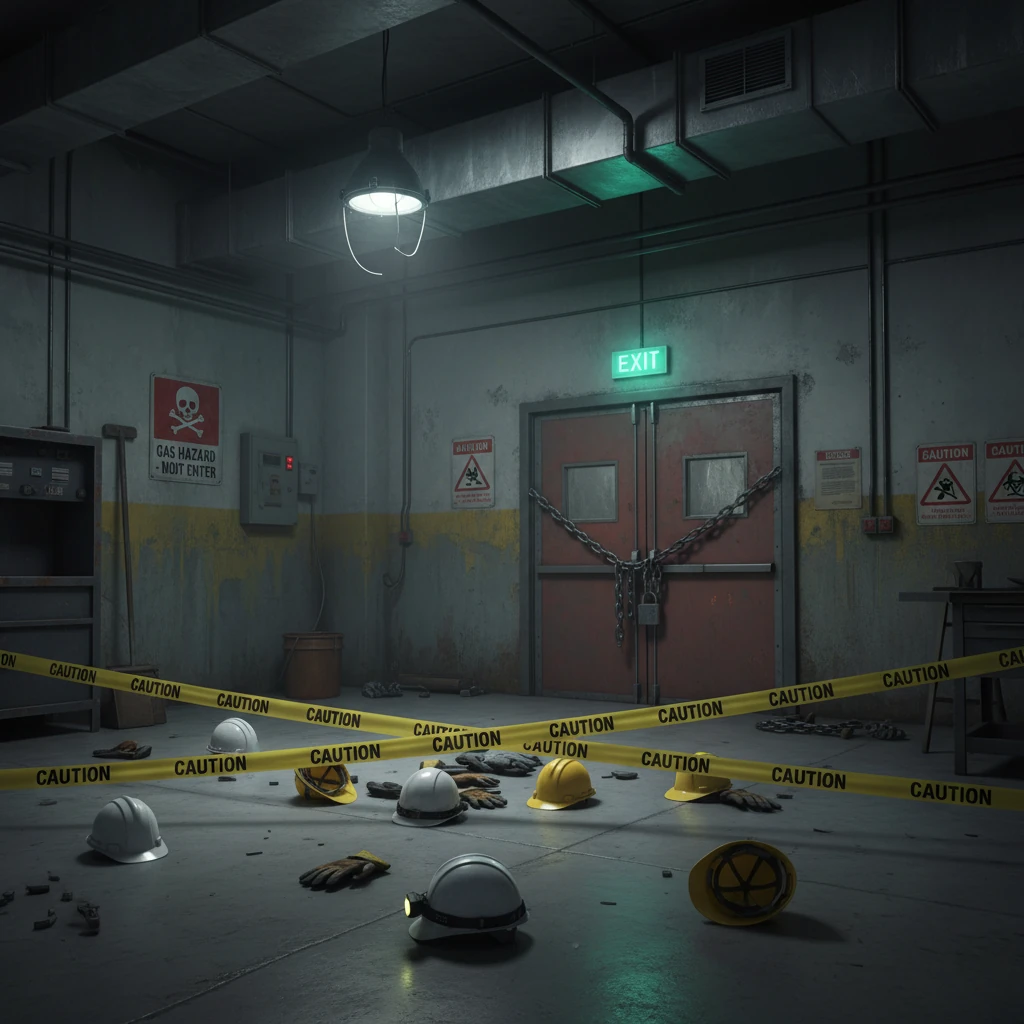
Safety Failures Lead to Death of 9 Workers in Isfahan Industrial Zone Locked Workshop Doors and Employer Negligence Under Judicial Investigation
According to the Workers’ Health and Safety Support News Agency, citing ILNA, a fatal incident at the Saman Madar Pishro manufacturing unit, located in the Dolatabad Industrial Zone of Borkhar County, Isfahan Province, has once again highlighted serious shortcomings in occupational health, safety, and environmental (HSE) compliance in industrial workshops.
The incident occurred on December 15, resulting in the deaths of nine workers, several of whom were young women and heads of households. In the immediate aftermath, limited information and conflicting accounts created uncertainty regarding the causes and circumstances of the incident, prompting intensified investigations by judicial and regulatory authorities.
In this regard, Zahra Asgari, Director of Labor Relations at the Isfahan Provincial Department of Cooperatives, Labor, and Social Welfare, provided details on the preliminary findings.
Judicially Coordinated Multi-Agency Investigation
She stated that following the incident
multiple expert sessions were held under the supervision of the Public Prosecutor’s Office. During the first official session, it was decided that all relevant agencies would conduct a simultaneous and coordinated on-site inspection. Accordingly, inspection teams from the Departments of Labor, Industry, Mine and Trade, Fire Department, Municipality, Governorate, and the Forensic Medicine Organization carried out field investigations under judicial oversight.
Asgari added that, by decision of the coordinating committee, detailed findings would remain confidential until all technical, forensic, and safety reports are finalized and consolidated.
Incident Not a Major Fire; Toxic Gas Identified as Cause of Death
According to Asgari, preliminary assessments
indicate the incident was not a large-scale fire. A limited electrical fault in electronic equipment used in the workshop triggered the release of a toxic gas into the workspace.
She emphasized that forensic reports show no signs of burns or fire-related physical injuries on the victims’ bodies. The confirmed cause of death was inhalation of toxic gas leading to suffocation.
Locked Emergency Exits and Lack of HSE Infrastructure
Asgari noted that
while some workers initially managed to evacuate the premises, the workshop doors were subsequently locked, trapping nine workers inside the contaminated environment. Investigations further revealed that the workshop lacked essential safety equipment, emergency response systems, adequate ventilation, clearly marked emergency exits, and basic HSE training.
These serious deficiencies, she said, played a decisive role in aggravating the consequences of the incident.
Violation of Legal Obligations and HSE Standards
Referring to the legal responsibilities of employers, Asgari stated that under Iranian labor law, employers are required to comply with all occupational safety standards and legal licensing requirements prior to operating a workshop.
In this case, it has been confirmed that the company failed to obtain the mandatory operating permit stipulated under Article 87 of the Labor Law, and that risk assessment procedures, safety training, and protective measures demanded by HSE regulations were not implemented.
She stressed that while there is currently no evidence of intentional wrongdoing, the determination of negligence and the assignment of civil and criminal liability fall under the jurisdiction of the judiciary and will be decided upon completion of expert evaluations.
Call for Stronger Preventive HSE Oversight
The tragedy has renewed calls by labor and safety experts for strengthening preventive HSE inspections, enforcing compliance in industrial workshops, and taking decisive legal action against facilities operating without proper licenses or safety standards—measures deemed essential to preventing similar human disasters in the future.
- source:HSENK
- author:DGS
- 1404/10/05