
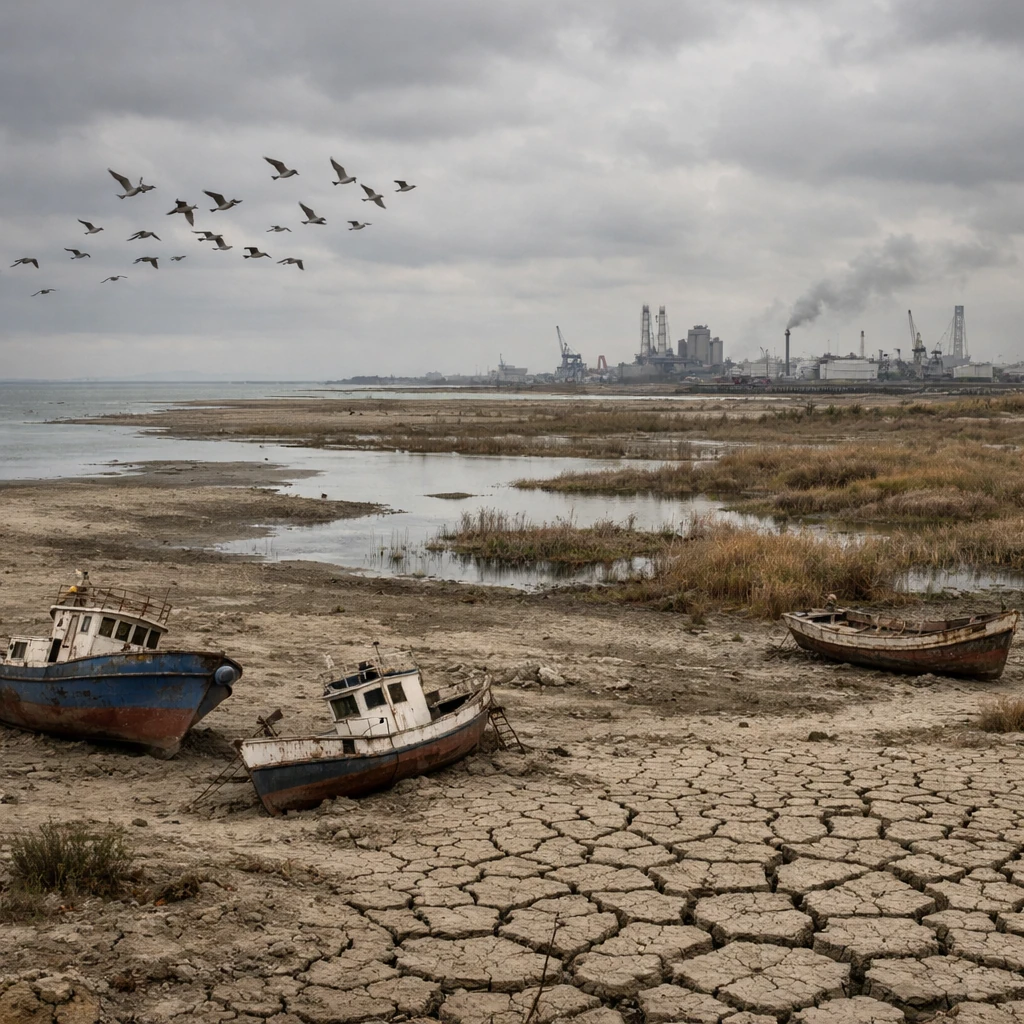
Declining Caspian Sea Water Levels: A Critical HSE Warning for Coastal Communities, Infrastructure, and Regional Environmental Security
According to the Supporters of Occupational Health and Safety News Agency (HSE), citing ILNA, Ahmadreza Lahijan-Zadeh, Deputy Head for Marine and Wetland Environment at Iran’s Department of Environment, warned about the continuing decline in the Caspian Sea’s water level during the conference entitled “Resilience and the Nexus of Energy, Water, Environment, and Food Security in Development Planning”, held at Sharif University of Technology.
He described the phenomenon as one of the most critical strategic challenges with far‑reaching HSE implications for the region and emphasized the urgent need to revise development planning models in line with future climate scenarios.
Referring to long-term monitoring data and climate analyses, Lahijan-Zadeh explained that the decline in the Caspian Sea’s water level is the result of a combined impact of natural and human-induced factors, including rising temperatures, intensified evaporation, changes in precipitation patterns across the basin, and reduced inflow from major rivers. He noted that predictive scenarios indicate the continuation of downward fluctuations unless effective and coordinated regional interventions are implemented.
The Deputy Head stressed that falling water levels could lead to shoreline displacement, land-use change, the emergence of dust hotspots, and increased pressure on coastal infrastructure, posing serious environmental, safety, and public health risks.
Elaborating on the socio-economic dimensions of the issue, Lahijan-Zadeh stated that the impacts of the Caspian Sea’s retreat extend far beyond environmental degradation. Livelihoods of coastal communities, occupational safety, fisheries, port operations, tourism, investment security, and employment sustainability in northern regions are all at risk, potentially triggering broader social and economic instability if left unaddressed.
Citing the Public Relations Office of the Department of Environment, he warned that in the absence of a coherent adaptation and HSE risk management plan, the economic costs associated with declining resource productivity, underutilized infrastructure, and escalating environmental hazards would far exceed the costs of preventive and corrective measures.
Highlighting the situation of Gorgan Bay as one of the most vulnerable areas, Lahijan-Zadeh identified reduced water exchange, rising salinity, degradation of aquatic habitats, and threats to migratory bird populations as major ongoing challenges. He cautioned that the continuation of these trends could severely disrupt the ecological functions of coastal wetlands in Iran and other Caspian littoral states, leading to transboundary environmental and health consequences.
He further announced the development of a “Regional Adaptation Framework for Caspian Sea Regression”, aimed at strengthening cooperation among coastal countries, enhancing the exchange of monitoring data, defining joint projects, and mobilizing international financial and technical capacities. He noted that the framework will be presented at the upcoming Conference of the Convention on the Protection of the Marine Environment of the Caspian Sea, underscoring that an effective response to declining water levels requires an integrated, science-based approach grounded in regional collaboration.
- source:HSENK
- author:DGS
- 1404/11/27