
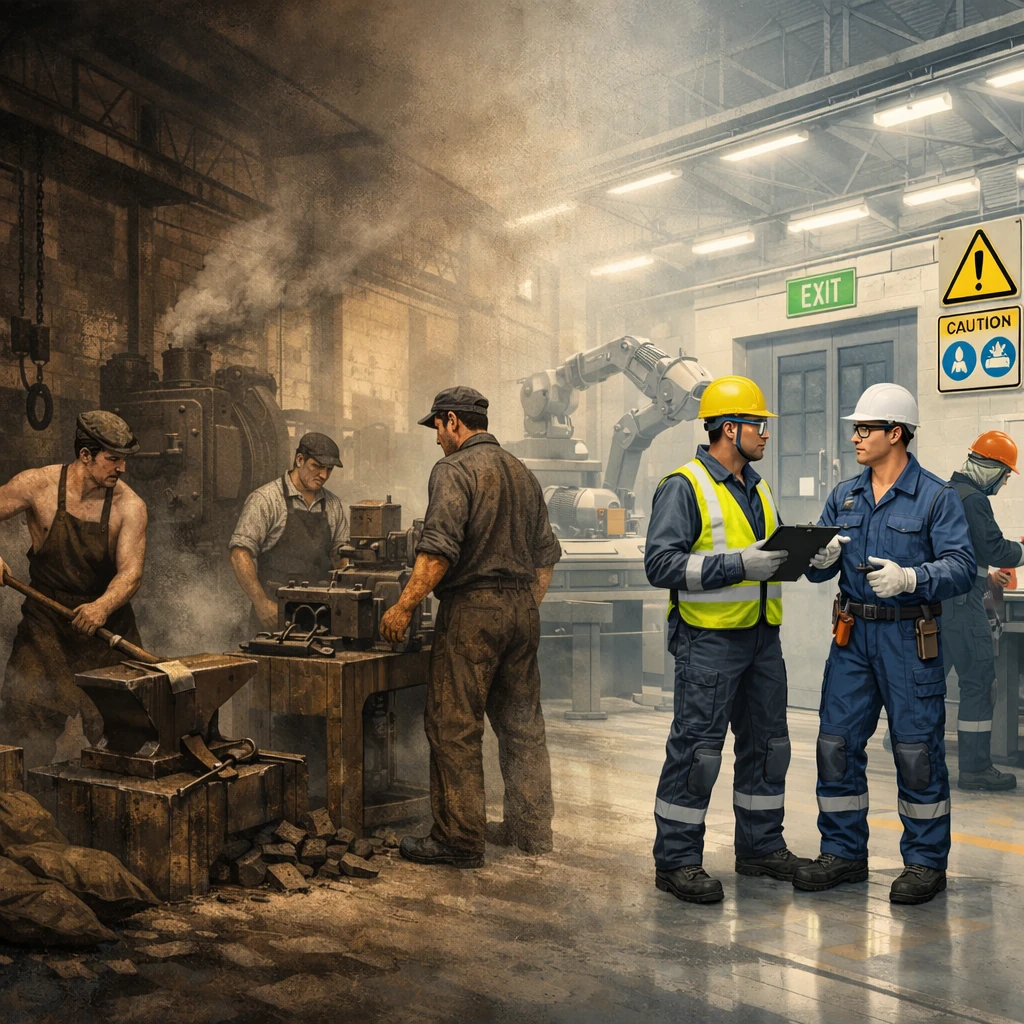
Safety: From the Hard Lessons of the Industrial Revolution to the Institutionalization of HSE Culture
Today, Health, Safety, and Environment (HSE) is recognized as one of the fundamental pillars of sustainable development and the protection of human capital. This concept, however, is the result of years of experience, hardship, and tragic incidents throughout the history of global industry.
A review of safety history shows that during the 18th and 19th centuries, coinciding with the early stages of the Industrial Revolution, workers in mines, factories, and workshops were forced to work 12 to 14 hours a day without any form of personal protective equipment. At that time, there were no safety helmets, gloves, protective footwear, or safety training. If a worker was injured, the responsibility lay solely with the individual—not the employer—resulting in thousands of occupational accidents each year with no compensation or legal support.
These harsh and unjust conditions eventually led to growing awareness. In 1833, the United Kingdom took a significant step by enacting the first legislation to limit working hours and protect workers. For the first time, government inspectors were authorized to enter factories and assess working conditions—an important milestone that marked the beginning of formal safety oversight systems worldwide.
Another major turning point in the history of safety occurred in 1911 with the Triangle Shirtwaist Factory fire in New York City. Due to locked exit doors, more than 140 workers—most of them women—lost their lives in the fire. The tragedy shocked the world and led to the drafting and enforcement of the first comprehensive and mandatory safety regulations in the United States. From that point on, safety was no longer merely a recommendation; it became a legal obligation.
As industries expanded, safety practices evolved accordingly. Personal protective equipment such as safety helmets, impact-resistant footwear, and heat-resistant gloves gradually became standard in workplaces. At the same time, safety training emerged as an inseparable component of industrial operations. Workers learned how to protect themselves, and employers came to understand that without safety, sustainable production and productivity are impossible. This understanding gave rise to the well-known principle: “Safety first, then work.”
Today, safety goes beyond laws and regulations—it has become an organizational culture. In major industries such as steel, mining, and energy, safety represents respect for human life and the belief that no progress is meaningful without the health and well-being of workers. With the advancement of modern technologies, including monitoring cameras, sensors, and intelligent safety systems, HSE frameworks are becoming more accurate, faster, and more effective every day.
Experts agree that the history of safety is, in essence, the history of respect for humanity—a journey shaped by the suffering and experience of previous generations. Every warning sign, every safety training session, and every preventive action is a continuation of that path. Wherever safety is upheld, peace of mind, productivity, and sustainable development will follow.
Source:https://hsenk.ir/
- author:DGS
- 1404/11/30