
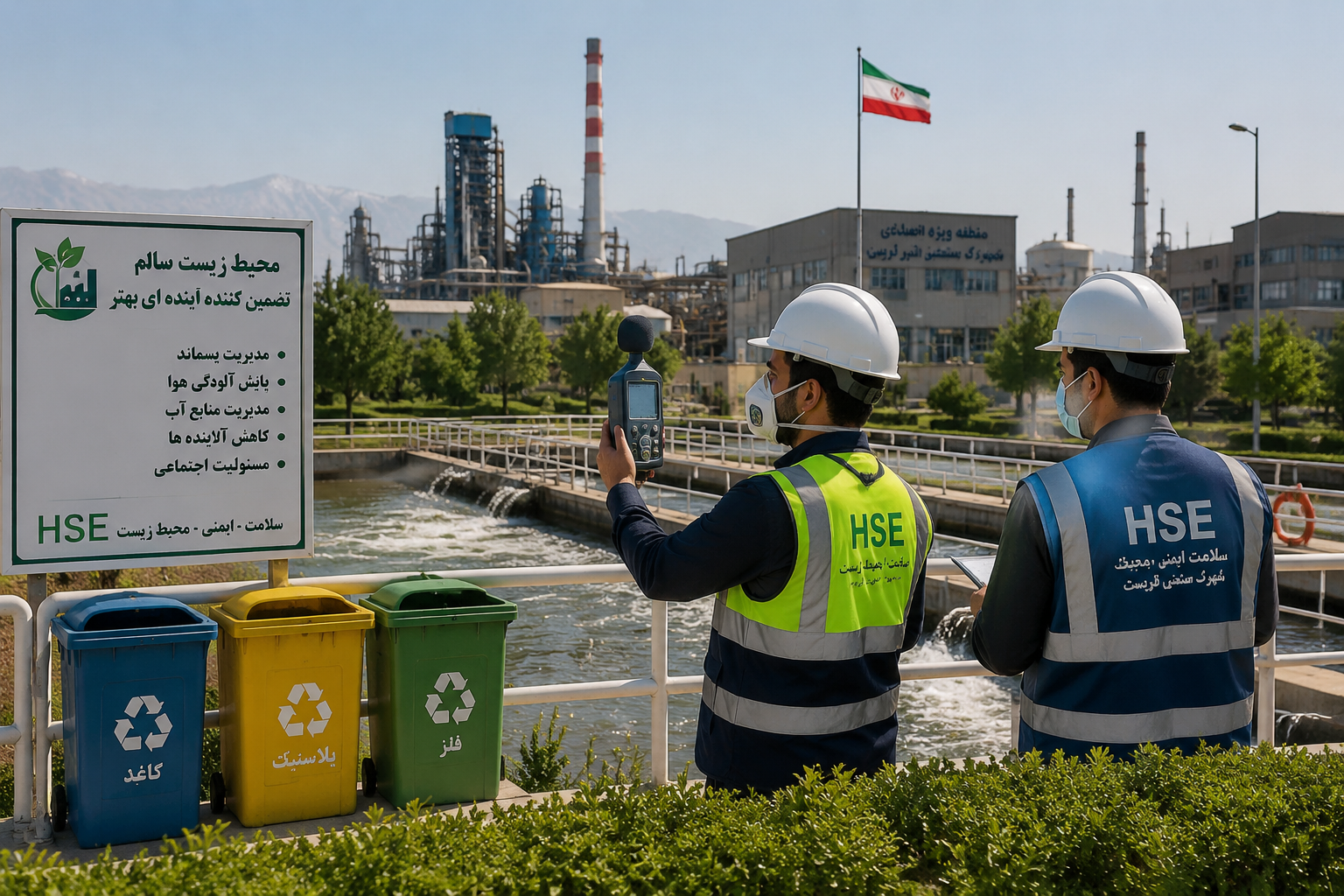
Water Resource and Waste Management Identified as Key HSE Priorities in Qazvin Province
Date: June 15, 2026
In line with strengthening Health, Safety, and Environment (HSE) approaches in Qazvin Province, the Director General of the Provincial Department of Environment outlined the region’s most pressing environmental challenges and emphasized the need for sustainable water resource management, pollution control, and improvements in waste management systems.
According to the Workers’ Health and Safety Support News Agency, citing the Public Relations Office of the Department of Environment, Seyed Asadollah Hashemi, Director General of the Department of Environment of Qazvin Province, stated that water scarcity, ongoing drought conditions, air pollution, and waste management issues are among the most significant environmental challenges facing the province, directly affecting public health, workplace safety, and sustainable industrial development.
He noted that proper water resource management is a fundamental component of HSE policies, adding that preventing the establishment of water‑intensive industries and expanding the recycling and reuse of treated wastewater in industry and agriculture are currently among the province’s top environmental priorities.
Referring to air pollution, Hashemi explained that the formation of internal and external dust sources during the summer, along with pollutants generated from fossil fuel consumption, urban traffic, and industrial activities during the winter season, are major contributors to declining air quality in the province. He added that despite improved vegetation coverage due to favorable rainfall this year, some dust particles originate from outside the province and even from transboundary sources.
Highlighting the Clean Air Law, he stated that the responsibilities of executive agencies in controlling air pollution have been clearly defined, and the provision of standard fuels for industries and power plants falls under the responsibility of the Ministry of Oil. Proper implementation of this law can significantly reduce pollutant emissions.
Hashemi identified waste management as another major environmental challenge in the province. He explained that despite the operation of two centralized municipal and industrial waste disposal sites, weak waste separation at the source and insufficient processing have led to a large portion of waste being directly landfilled. This situation has resulted in unpleasant odors, the spread of plastic waste in surrounding lands, and dissatisfaction among nearby rural communities.
The Director General also pointed to issues related to land‑use planning, stating that the failure of some agencies to adhere to territorial planning documents has placed excessive pressure on the province’s ecological capacity, particularly in central areas. He added that the establishment of water‑intensive industries relying on groundwater resources remains a serious concern.
He also highlighted monitoring and pollution control efforts in the province, noting that continuous environmental monitoring and stricter supervision have led to the identification of new polluting units and improvements in the environmental performance of several industrial facilities. Additionally, renovation projects and wastewater treatment systems have been implemented in several dairy farms in Abyek County.
Other actions include organizing unauthorized recycling units in Qazvin County and addressing environmental issues related to raisin‑processing facilities in Takestan County, which have been required to install wastewater treatment systems.
He added that four provincial waste management task force meetings and one meeting of the Crime Prevention Council focused on waste management issues were also held. Key topics included waste separation at the source, the organization of the Mohammadabad waste site, acceleration of the new landfill project, and leachate management and recycling.
According to Hashemi, the main obstacle to resolving environmental challenges in the province is the incomplete implementation of environmental laws and upstream policy documents by some institutions. He emphasized that full enforcement of the Clean Air Law and adherence to territorial planning policies could significantly reduce many of the province’s environmental problems.
In conclusion, he stressed that managing water resources, preventing the establishment of water‑intensive and wastewater‑producing industries, replacing outdated industries with modern technologies, and moving toward a low‑carbon economy are among the key priorities for the province’s environmental strategy.
He also identified smart environmental monitoring systems for industries, expansion of specialized laboratories, and strengthening human resources as major future programs of the Qazvin Department of Environment. With more than 4,000 industrial and production units operating in the province, he noted that strengthening monitoring infrastructure, technical capacity, and professional staffing is essential to effectively oversee environmental compliance.
..
مدیرکل حفاظت محیطزیست استان قزوین همچنین اعلام کرد: پروژه بررسی احتمال نفوذ شیرابه سایت پسماند محمدآباد به منابع آب زیرزمینی با همکاری دانشگاه بینالمللی امام خمینی(ره) در دست مطالعه و تدوین است تا مخاطرات احتمالی زیستمحیطی بهصورت علمی ارزیابی شود.
.
.
.
.
author:DGS