The HSE information platform reports that expanding industrial monitoring systems, office automation and portable smart devices have prompted occupational health managers to emphasize blue-light exposure assessment and cognitive and visual ergonomics at workstations.
According to Webda, citing the Ergonomics Department of Shiraz University of Medical Sciences, assessment of harmful physical workplace agents indicates that uncontrolled exposure to short-wavelength visible light, stated as 380–500 nm, can create physiological challenges for occupational health and biological rhythms.
Circadian disruption and reduced work performance
Dr. Reza Kazemi, associate professor of ergonomics and university faculty member, explained that blue light naturally promotes cortisol release, concentration and wakefulness early in the day. However, the report states that chronic evening and night exposure can suppress melatonin by more than 50%, disrupting the sleep cycle, described in the source as deep sleep (REM), causing severe shift fatigue and reducing operator alertness. In sensitive control rooms, this can increase human-error risk.
He identified night-shift workers, control-room monitoring staff, IT support personnel and employees using digital screens continuously for more than six hours daily as higher-risk occupational groups.
Computer vision syndrome and workstation risks
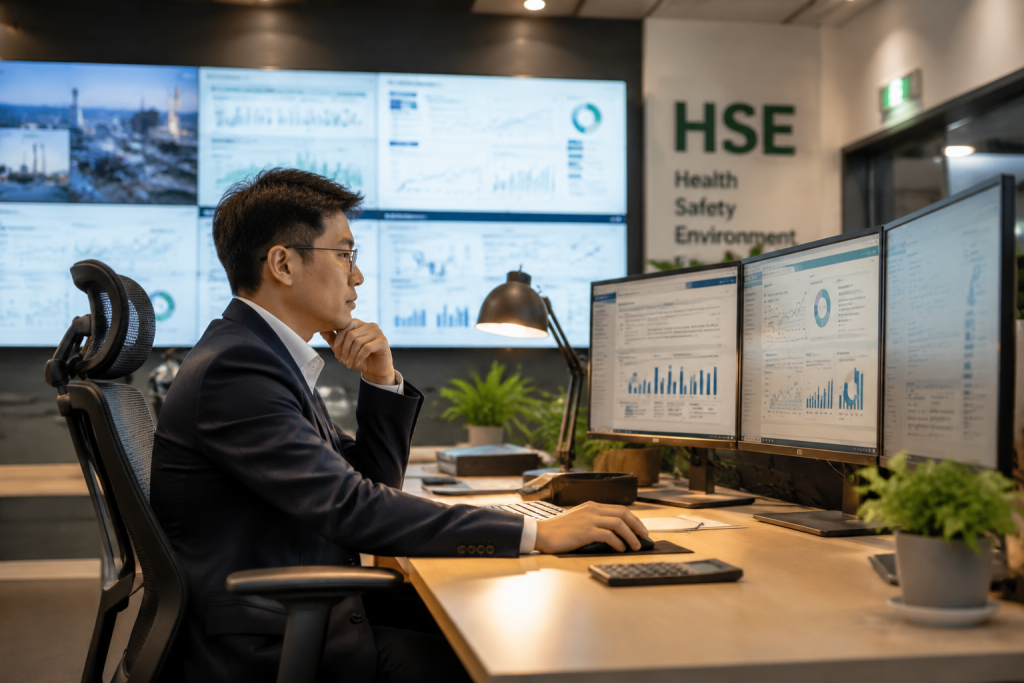
The ergonomics specialist said intensive screen use without regular breaks can reduce blinking from approximately 18 to 4–6 times per minute. This can contribute to dry eye, conjunctival inflammation, temporary blurred vision and tension headaches associated with visual accommodation. Technical and administrative staff are frequently affected, requiring ergonomic intervention.
Addressing organizational responsibility toward future generations, he added that children's highly transparent lenses and limited pigmentation provide less natural filtering, allowing more high-energy light to reach the retina. Families should therefore carefully supervise digital-device use before bedtime.
HSE management and engineering measures
– Apply the 20-20-20 rule: after every 20 minutes of screen viewing, look at an object 20 feet, approximately six meters, away for at least 20 seconds to relax the eye's focusing muscles.
– Configure software and hardware filters: activate blue-light reduction automatically from the middle of the day, adjust display color temperature, stated as below 4,000 K on night shifts, and use anti-glare coatings.
– Engineer general workplace lighting: balance task and ambient lighting within occupational-health limits appropriate to offices, eliminate direct glare and avoid reflections from windows and ceiling lights.
– Adjust screen height and viewing angle: position the screen's top edge at or slightly below eye level, allowing a downward viewing angle of 10–20 degrees, with a viewing distance of 50–70 cm.
– Screen vision periodically: include optometry and dry-eye screening in occupational medical examinations to prevent chronic visual problems and support employees' physical and psychological safety.
Source links: hsenk.ir
Original publication date (Solar Hijri): 1405/06/13
Author: Dibagostaran Sanat