
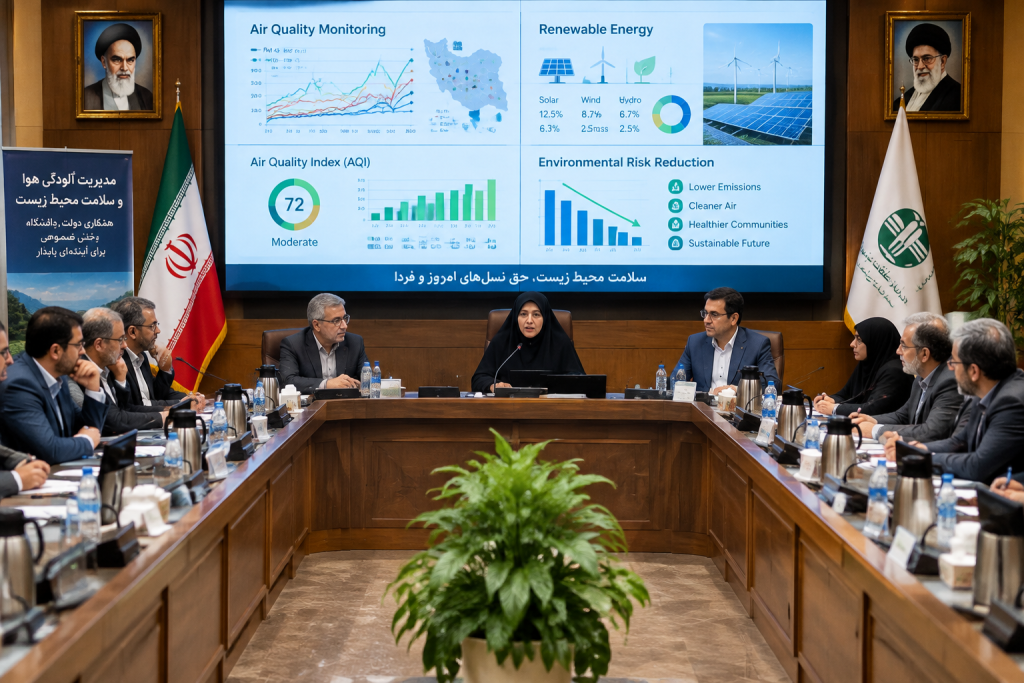
At a government–university consultation, the head of the Department of Environment identified air pollution control as a key public-health and environmental priority, emphasizing scientific modeling, replacement of aging vehicles and clean energy.
The Workforce Health and Safety Supporters news outlet, citing the Department's public relations office, reported that the joint government–academic working group met on Monday morning at the Department. Participants included Vice-President Shina Ansari, Tarbiat Modares University President and working-group chair Yousef Hojjat, and environmental engineering and occupational-health academics.
Linking expertise with national HSE decisions
Ansari described air pollution as a major environmental and public-health challenge. Knowledge-based management and health-risk assessment are essential, with academic advice providing strategic support for executive decisions.
Referring to presidential social surveys in 1403 (Solar Hijri), she said strong public demand for clean air increases the responsibility to improve environmental indicators. Understanding the problem's multiple dimensions and learning from government–university cooperation in water-resource management should guide air-pollution control.
From cleaner fuel to sulfur dioxide monitoring
Despite energy imbalances, sanctions and financial constraints, preventive HSE action has continued. Ansari cited distribution of approximately 420 million liters of low-sulfur fuel oil to power plants near population centers in the previous year. At Shazand Power Plant, the report states that this helped reduce sulfur-dioxide-related polluted days in Arak from 28 in 1403 to two in 1404, reducing respiratory and public-health risks.
More than 650,000 old vehicles were reportedly scrapped over two years. Revised implementing regulations under Article 10 of the Automotive Industry Organization Law introduced incentives to accelerate recycling and fleet renewal.
Fleet renewal, technical oversight and industrial standards
Key mobile-source measures included:
– Replacing commercial vehicles and tractor units over 50 years old through energy-saving certificate mechanisms;
– Introducing electric and hybrid vehicles into municipal and ride-hailing fleets, alongside replacing and scrapping 20,000 old motorcycles with standard electric models;
– Requiring standard catalytic converters, stronger end-of-production-line oversight and integrated national vehicle-inspection systems connected to online government platforms.
A 400% increase in renewable capacity
Ansari described clean energy as fundamental to reducing carbon footprints and industrial pollution. She reported that renewable capacity had risen from around 1,200 MW at the start of 1403 to nearly 6,000 MW, helping reduce greenhouse gases and fossil-fuel dependence.
Coordinated priorities without parallel structures
Referring to decisions from 14 national air-pollution working-group meetings under the fourteenth government, she called for academic proposals to be structured into short-, medium- and long-term programs. Priorities should be low-cost, high-impact measures informed by emissions inventories, implemented within agencies' legal responsibilities without duplicated structures.
She concluded that persistent environmental challenges require phased planning, continuous monitoring and cooperation among government, universities and industry to secure the public's right to a healthy and safe environment.
Source links: hsenk.ir
Original publication date (Solar Hijri): 1405/06/18
Author: Dibagostaran Sanat