
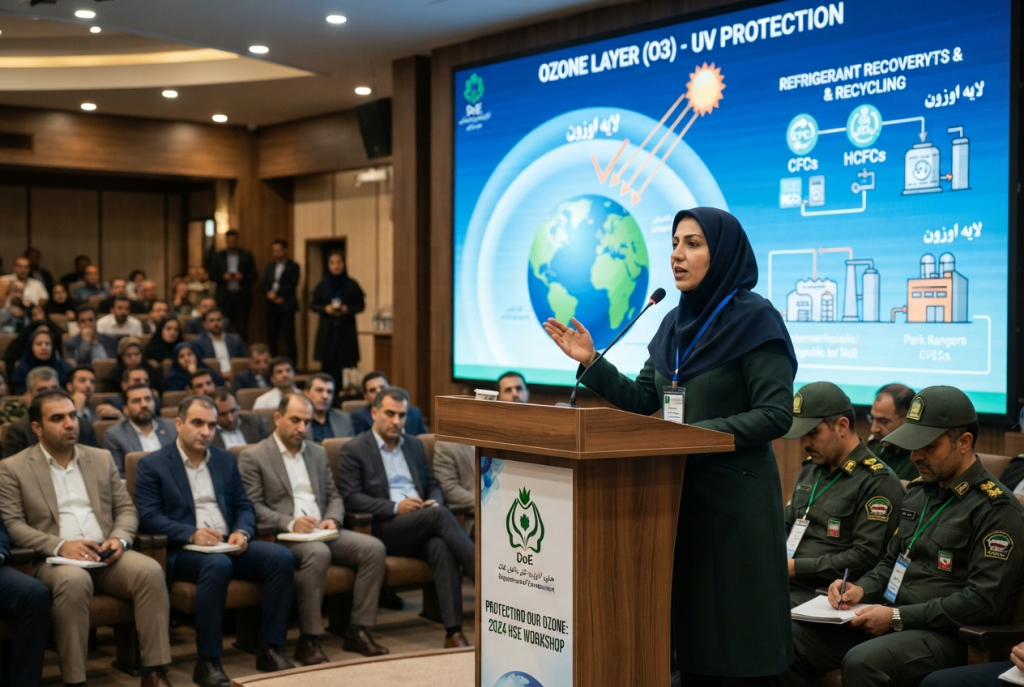
Tehran — According to Mehr News Agency and the Department of Environment, an event marking the Montreal Protocol's 39th anniversary and International Day for the Preservation of the Ozone Layer was held on 24 Shahrivar. Participants included the Department's head, HSE managers and advisers, international agencies, environmental organizations and refrigeration and chemical industry representatives.
The meeting reviewed three decades of atmospheric pollution control, environmental-health standards and safer green technologies in manufacturing and services.
Environmental commitments, public health and climate resilience
Vice-President Dr. Shina Ansari described the Montreal Protocol and Vienna Convention as successful international examples of integrated environmental management, science-based policymaking and environmental risk assessment. Their central aim is phasing out ozone-depleting substances to protect ecosystems and reduce carcinogenic ultraviolet exposure.
She linked the commitments to climate mitigation through the Kigali Amendment. Replacing HFCs with low-global-warming-potential alternatives and improving refrigeration and air-conditioning efficiency are important to sustainable development and reducing cities' thermal pollution burden.
Ansari also noted regional conflict's damaging effects on infrastructure, sensitive ecosystems and ranger facilities. Comprehensive environmental protection requires lasting peace and support for national and international HSE infrastructure.
Ranger occupational health and ground-level ozone
Dr. Saeed Mahmoudi distinguished protective stratospheric ozone from ground-level ozone. Tropospheric ozone is a hazardous secondary pollutant formed under strong sunlight from nitrogen oxides and volatile organic compounds. Controlling these precursors is an environmental-health priority.
He said rangers and field-monitoring staff face prolonged high UV exposure. Dedicated health protocols, improved protective clothing and standard ergonomic and radiation-protective equipment are therefore Department HSE priorities.
Ozone-depleting substances and the 2028 refrigerant roadmap
Dr. Hossein Shahbaz discussed substitution projects, describing Iran as a regional leader in eliminating CFCs and halons. The roadmap toward 2028 includes capacity building for HCFC replacement and approval of HFC-control strategies across industrial, automotive and facilities sectors.
He reported more than 300 specialist workshops, over 22,000 person-hours of safety and process training, and hundreds of technicians trained and certified in refrigerant recovery and safe disposal. These activities aim to minimize leaks, poisoning and atmospheric releases.
Operational HSE priorities
– Chemical safety: supervise import, transport, storage and use of lower-risk refrigerants, ammonia, carbon dioxide, isobutane and other natural refrigerant gases.
– Ranger health: assess radiation exposure and provide protective clothing and standard UV400-blocking eyewear for outdoor staff.
– Refrigerant recovery: establish safe collection stations for hazardous gaseous waste to prevent uncontrolled atmospheric discharge.
– Energy efficiency and process decarbonization: require efficient energy ratings for refrigeration equipment in line with carbon-footprint reduction.
Source links: www.mehrnews.com
Original publication date (Solar Hijri): 1405/06/24
Author: Dibagostaran Sanat