Alongside high-level international meetings, the International Labour Organization emphasized wages reflecting actual household needs and job security as foundations of occupational health and incident prevention. HSE and labour-relations specialists warn that a widening gap between earnings and inflation increases burnout, acute job stress and fatal incident risk, requiring attention from Iran's technical protection authorities and labour policymakers.
1. Occupational health and financial stress
The source describes recent ILO reports as extending occupational health beyond physical, ergonomic and chemical hazards to psychosocial factors. Income insecurity and poverty disrupt concentration and increase near misses and serious industrial incidents.
A safe and healthy workplace, recognized as a fundamental right in 2022, requires a living wage. Workers forced into excessive overtime, consecutive shifts and multiple jobs to meet healthcare, food and housing costs face slower reactions, chronic muscular fatigue and reduced concentration, increasing individual and collective injury risks.
2. Iran's labour market and national standards
The report links this approach to Article 85 and technical protection and occupational-health regulations. It attributes a substantial share of human-error-related failures in construction, mining and contracting to exhaustion and workers' financial concerns.
The distinction between a statutory minimum and a living wage also reflects Article 41, especially its requirement to consider the actual costs of a standard household. HSE specialists describe wage setting as a direct preventive intervention in occupational-health risk assessment, as well as a financial matter.
3. Ergonomic and emerging risks in platform work
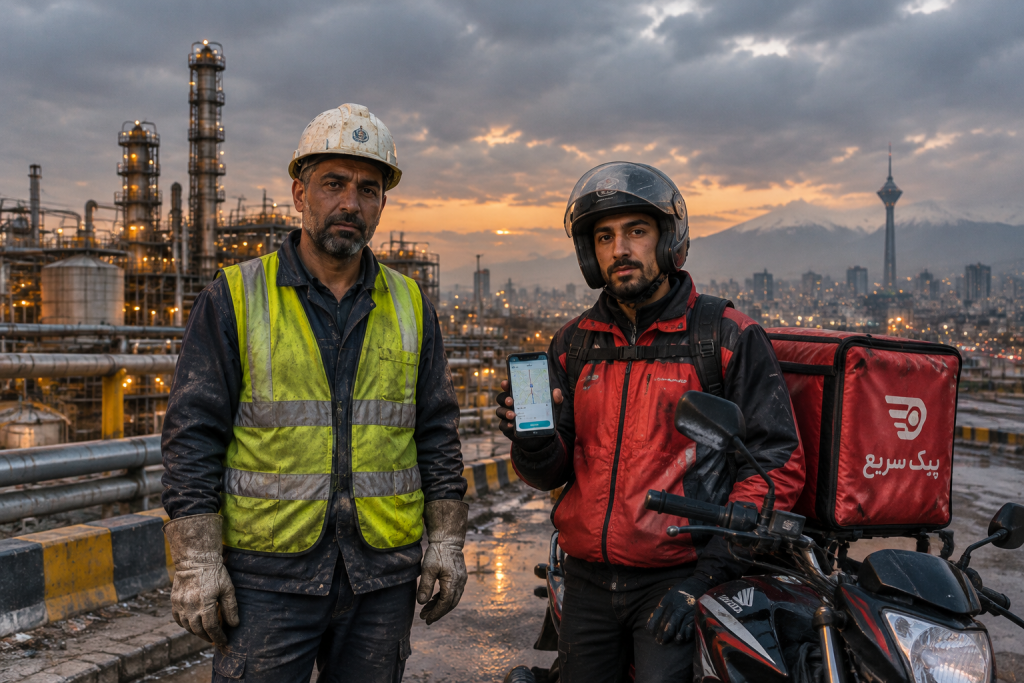
The original report refers to a new ILO instrument on decent work in the platform economy as Convention No. 193. It discusses hundreds of thousands of motorcycle couriers and drivers working on rapidly expanding digital passenger and logistics platforms in cities such as Tehran, often without HSE protection:
– Traffic and ergonomic risks: prolonged uninterrupted work loads the spine, exposes workers to atmospheric pollutants and may involve equipment below safety standards.
– Missing incident and disability cover: the standards described in the report call on digital employers to avoid shifting all financial and legal responsibility for life-threatening risks and PPE onto platform workers.
4. Artificial intelligence and industrial automation
AI and robotics in manufacturing, petrochemicals and logistics create cyber-physical safety and mental-health challenges. Safety by design should preserve human dignity, avoid excessive biometric surveillance and reduce isolation-related stress. Technology should support predictive hazard identification and reduce exposure to arduous and harmful conditions.
5. A just transition for carbon-intensive industries
In an economy relying on energy-intensive and oil and gas industries, low-carbon transition policies should not cause abrupt project suspension, layoffs or neglect of hazardous-work retirement standards. Retraining in environmental safety and industrial waste management is essential.
Organizational policy recommendations
– Strengthen periodic labour and health inspections, including workshops with fewer than ten workers, and formalize informal workers' contracts to extend occupational-incident insurance.
– Incorporate HSE into compensation packages through welfare benefits, mental-health screening and industrial nutrition.
– Establish comprehensive platform safety rules requiring employer liability insurance and periodic occupational medical examinations for ride-hailing and delivery services.
Source links: www.ilo.org
Original publication date (Solar Hijri): 1405/06/26
Author: Dibagostaran Sanat