
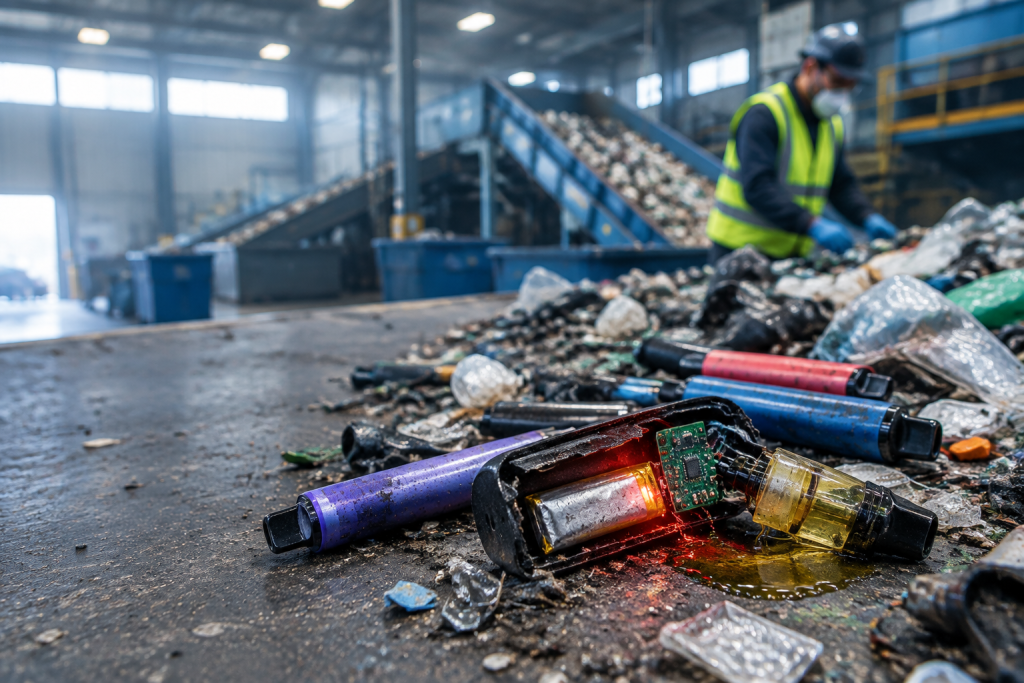
According to Mehr News Agency, growing disposable e-cigarette use among young people has created a special-waste management, urban safety and water-and-soil protection challenge beyond individual respiratory effects. University of Illinois researchers reportedly found concerning quantities of lead, zinc and copper in discarded devices. Their compact, nonseparable design also creates fire risks in waste systems.
Heavy metals in liquids and the water–soil cycle
Laboratory assessments identified some widely used brands' cartridges and residual liquids as having among the highest lead contamination reported in electronic tobacco devices. The report states that contamination may originate in initial e-liquid formulation and nonstandard manufacture, as well as corroding solder or heating elements. Lower-income users of cheaper brands may consequently face greater toxic-metal exposure. Landfill leachate containing these metals can threaten groundwater.
Fire and process-safety risks
Lithium-ion batteries enclosed in compact, nonseparable plastic housings are a major safety concern. Collection and compaction in refuse trucks or transfer stations can damage cells, causing short circuits, thermal runaway and sudden ignition. International waste-processing fires illustrate the risk; without segregation protocols, Iranian municipal facilities may face similarly costly incidents.
Iran's regulatory and operational context
– Smuggling and absent quality monitoring: the source states that official import and sale are not authorized under relevant health and anti-smuggling rules, leaving much of the market supplied through informal channels. This undermines standardized liquid testing, heavy-metal control and health certification.
– Waste management concerns: the report links batteries and heavy metals to special and hazardous waste under the Waste Management Law of 1383 (Solar Hijri). Without formal extended producer responsibility and recycling for tobacco devices, thousands of batteries and circuits mix with household refuse and enter landfills.
– Secondary indoor exposure: despite perceptions of harmless vapor, office, industrial and commercial staff can inhale aerosols containing volatile compounds and heavy metals. Workplace safety and hygiene manuals should address this exposure.
Preventive HSE measures
– Provide separate collection for small electronic devices and batteries in healthcare, organizational and welfare facilities to reduce fires and leachate contamination.
– Explicitly include e-cigarettes and vaping in indoor and industrial smoke-free rules.
– Strengthen health and customs oversight of informal distribution and periodically test seized products to assess toxicity and respiratory exposure.
Source links: www.mehrnews.com
Original publication date (Solar Hijri): 1405/06/28
Author: Dibagostaran Sanat