
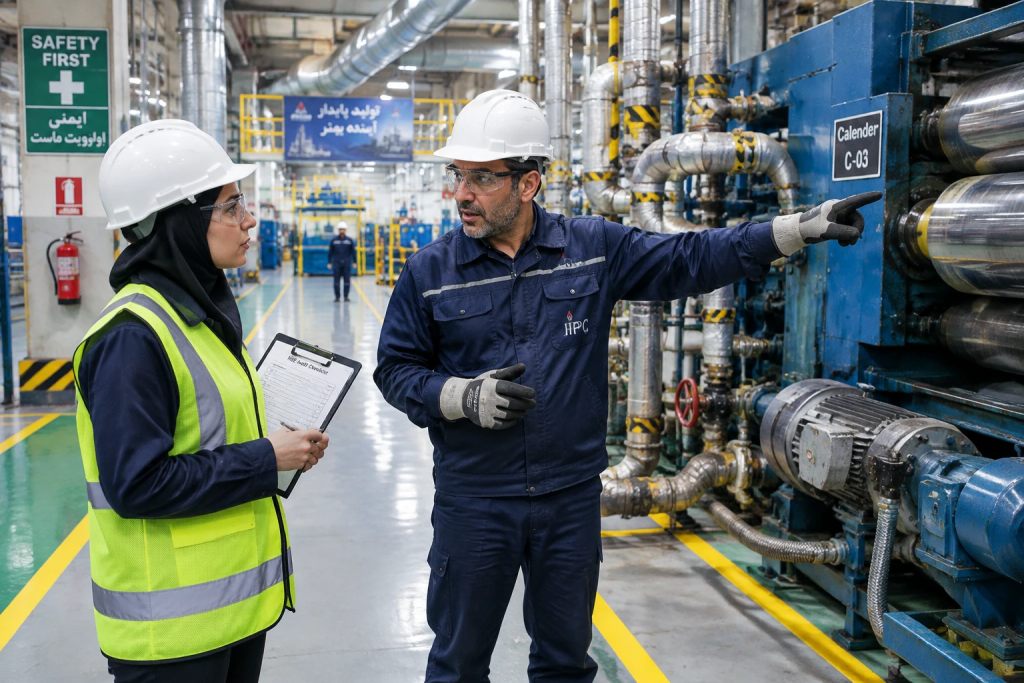
In line with international statements and national labour requirements, the International Labour Organization emphasized direct worker participation in hazard identification and risk assessment as the route beyond paper-based compliance. This is particularly important for reducing incident frequency and severity in petrochemicals, rubber manufacturing and heavy industry.
From employer benefit to fundamental legal right
Modern HSE assessment rejects the view of workplace safety as a discretionary employer benefit. Inclusion of occupational safety and health in the ILO's fundamental principles, associated with Conventions 155 and 187, establishes a right that cannot be waived.
In Iran, Articles 85, 91 and 92 of the Labour Law place responsibility for standard health and safety conditions on employers. Workers are entitled to protection against harmful physical, chemical and psychological factors.
Frontline production, assembly, processing and storage workers encounter dangerous conditions first. Risk assessment without their active participation and practical knowledge produces ineffective desk-based reports that cannot adequately prevent serious incidents and occupational disease.
Hazards throughout the production chain
Rubber and related chemical industries face:
– Chemical hazards: VOCs, toxic curing and vulcanization fumes, carbon-black dust and solvents contributing to chronic respiratory and occupational lung disease;
– Mechanical and physical hazards: entrapment in calenders and rollers, heavy-equipment noise and poorly matched tools;
– Psychosocial risks: consecutive shifts, burnout and work pressure, increasingly assessed within ISO 45001 and modern inspections.
Technical protection and occupational-health committees
The source states that Article 93 requires committees with worker, occupational-health and safety representatives in workplaces with more than 25 employees.
Weak knowledge transfer to frontline staff and unsuitable PPE remain major challenges. Effective HSE requires more than symbolic classes:
- Regular inspections using specialist checklists;
- Worker reporting of unsafe conditions and near misses without fear of punishment;
- Standard PPE matched to exposure, with practical training in use and maintenance.
International principles and Labour Ministry oversight
Iranian labour inspectors and occupational-health specialists undertake periodic monitoring under technical protection regulations. Specialists agree that ending a shift safely and returning home in good health is a foundation of economic productivity. HSE expenditure is an investment in preventing compensation costs, treatment, disability and damage to industrial facilities.
Source links: www.ilo.org
Original publication date (Solar Hijri): 1405/07/04
Author: Dibagostaran Sanat