
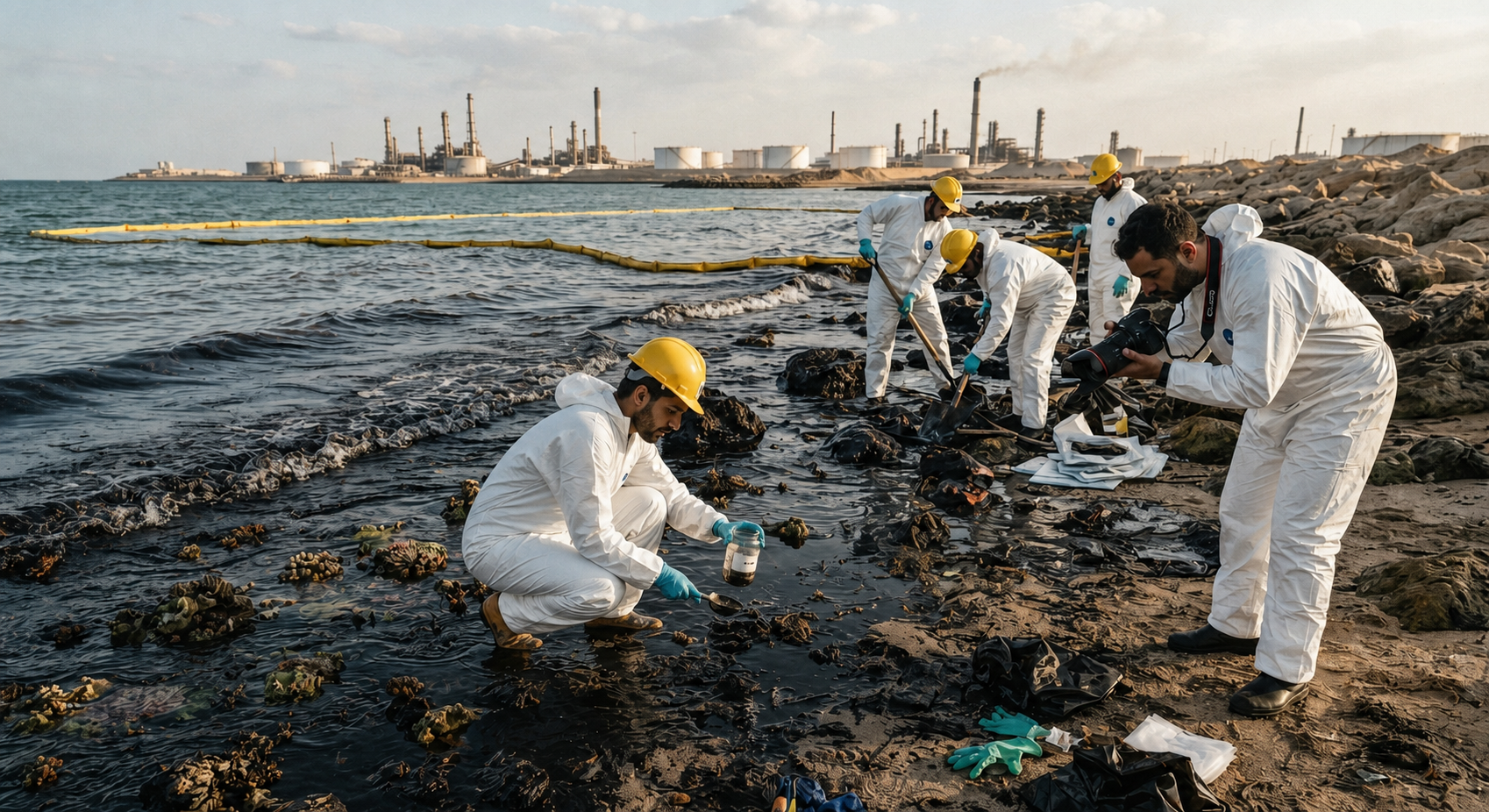
Environmental Alert Declared Across Southern and Northern Coasts; National HSE Directive Issued to Address Hydrocarbon Pollution and Conduct Emergency Monitoring of Sensitive Marine Habitats
Tehran – Public Relations and International Affairs, Department of Environment | Following incidents and damage caused by recent tensions affecting industrial infrastructure and maritime transportation, the Deputy for Marine Environment and Wetlands of the Department of Environment announced the launch of a special environmental monitoring plan, damage assessment based on HSE standards, and cleanup operations in the affected areas.
The Deputy for Marine Environment and Wetlands, while outlining the extent of damage inflicted on the sensitive ecosystems of the Persian Gulf and the Caspian Sea, emphasized the urgent need to activate passive defense protocols and industrial safety and HSE measures at ports and offshore oil facilities.
Shidvar and Lavan: Special Focus on Oil Spill Cleanup and Coral Reef Restoration
Ahmadreza Lahijanizadeh, referring to the oil spill incident near Lavan Refinery, stated:
“With the spread of oil pollution and its transfer through marine currents and waves to the shores of Shidvar Wildlife Refuge (Maru), one of the most unique island ecosystems and coral reef habitats in the Persian Gulf has come under serious threat. From the perspective of marine HSE indicators, contamination of rocky seabeds and coral communities with heavy hydrocarbon substances disrupts photosynthesis and the aquatic food chain, while the natural recovery of these areas may take decades.”
He added: “Shidvar Island is an internationally significant refuge and a critical nesting habitat for marine turtles—particularly the endangered hawksbill turtle—as well as migratory birds. Despite access limitations in border and military-sensitive zones, the Department of Environment is pursuing the urgent deployment of specialized monitoring and underwater documentation teams to accurately record the scale of damage to the seabed.”
Extent of Pollution: From the Coasts of Hormozgan to Bandar Anzali
The Deputy of the Department of Environment further explained other hydrocarbon pollution incidents:
- Persian Gulf and Sea of Oman: Following an attack on a fuel tanker in the strategic Strait of Hormuz, an oil slick affected approximately 240 kilometers of the Bandar Abbas coastline. In addition, several reports of localized pollution near Khark Island have been registered and assessed.
- Caspian Sea: Following an incident involving a military vessel in Bandar Anzali, around 150,000 liters of diesel fuel entered the port basin and adjacent coastal waters. Containment measures were rapidly implemented to prevent the spread of contamination toward the Anzali International Wetland.
Rapid Response Checklists (ERP) and Financial Assessment of Damages
According to the Marine Environment Deputy, drawing on lessons learned from recent crises, a comprehensive Environmental Emergency Response Plan (ERP) has been communicated to all provincial offices of the Department of Environment in coastal provinces. This directive includes specialized technical checklists that, immediately after an incident, identify and record key parameters such as spill dispersion speed, contamination depth, aquatic mortality rate, and the physical stability of shorelines.
Lahijanizadeh noted: “Environmental and economic damage assessments resulting from the loss of ecosystem services provided by coral reefs and mangrove forests have been carried out using international mathematical models. The monetary value of these losses, in both national and foreign currency terms, has been calculated. These reports have been referred to the relevant authorities for international legal follow-up and compensation claims.”
Interagency Cooperation for Biological and Physical Cleanup
In line with its sovereign responsibilities, the Department of Environment has held high-level coordination meetings with the Ministry of Oil and the Ports and Maritime Organization. At present, the first phase of environmentally compatible physical cleanup operations—using standard oil absorbents—has been completed in parts of the coastal areas of Khark, Shidvar, Lavan, Qeshm, and Bandar Abbas. Work is also underway on a comprehensive document titled “Cleanup and Biological Restoration of Areas Affected by Oil Pollution.”
- source:https://www.mehrnews.com/
- author:DGS
- 1405/05/01