
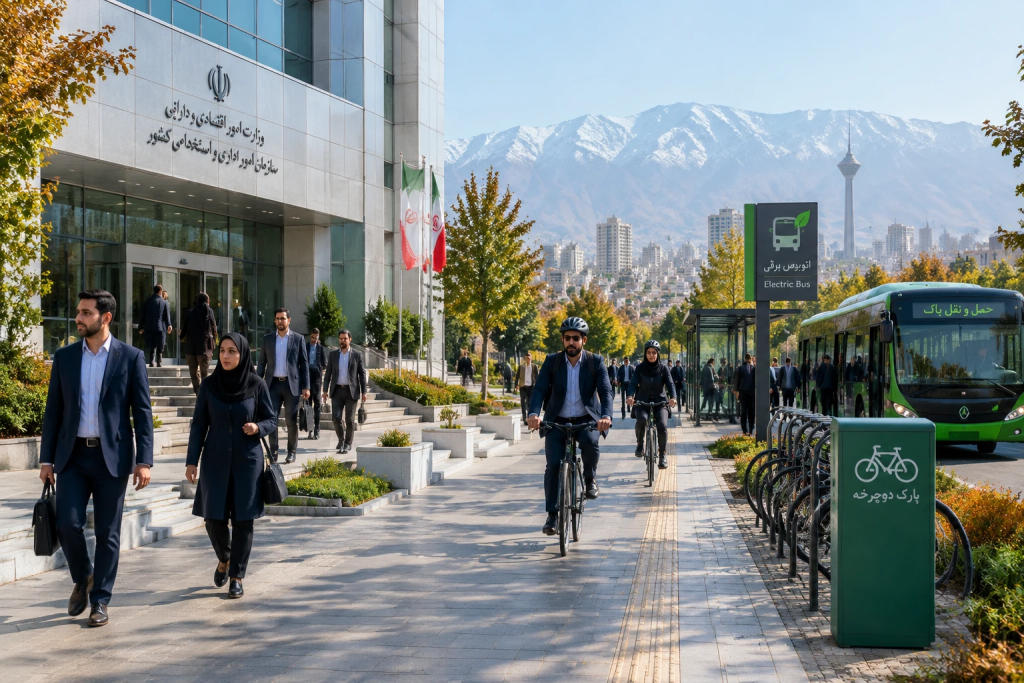
According to the HSE information platform, a presidential instruction and Administrative and Recruitment Organization directive placed a One Car-Free Day program on the agenda of all government institutions. Agencies were required to establish alternative commuting arrangements and prevent single-occupancy private-car commuting at least one day each week by the end of the current year.
Vice-President and Department of Environment head Dr. Shina Ansari described beginning within government as a move toward active public-health risk management. Government cannot expect voluntary public cooperation on pollution while lacking its own commitment to sustainability.
Timing with temperature inversion
Implementation during the second half of the year is important for environmental health. Annual inversions in Tehran, Isfahan, Mashhad, Tabriz and Arak trap fossil-fuel pollutants, including PM2.5, nitrogen oxides and VOCs, at critical levels.
Much of the burden reflects car dependence and unsuitable metropolitan infrastructure. Decades of prioritizing road development have weakened urban breathing spaces and people-centered planning.
HSE implementation requirements
The directive links sustainability to support infrastructure and an HSE framework. Organizational HSE units are tasked with:
– Managing employee travel: restore, standardize and optimize staff transport networks to improve shared-fleet efficiency and reduce traffic risks.
– Carpooling: provide systems and internal coordination for colleagues sharing overlapping routes.
– Active, sustainable transport: provide secure bicycle and electric-scooter facilities and supporting amenities at offices.
– Carbon-footprint monitoring: record and report monthly reductions in greenhouse gases and regulated pollutants resulting from the program.
From symbolic campaigns to lasting culture
Referring to earlier Car-Free Tuesday campaigns, Ansari said symbolism without operational support and practical alternatives cannot have lasting effects. The aim is a new workplace norm and stronger urban ecological resilience. Continuous monitoring, removal of commuting difficulties and parallel improvements to public transport are essential.
Outlook
The report views the program as supporting Article 29 of the Clean Air Law and ISO 14001 environmental management in the public sector. Government leadership in fuel efficiency and work-travel management could encourage wider public participation and cleaner air.
Source links: hsenk.ir
Original publication date (Solar Hijri): 1405/07/04
Author: Dibagostaran Sanat